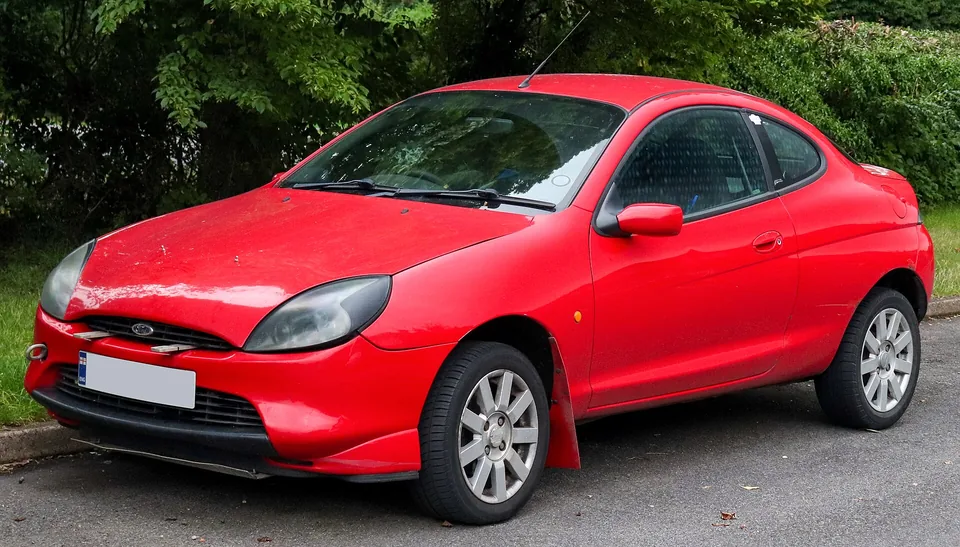
Ford Puma
Why 8.2: A Fiesta floorpan, a coupé body and a 1.7-litre engine co-developed with Yamaha — rough blocks were shipped from Ford's Valencia plant to Japan for Nikasil coating and variable cam timing. What came back was 125 PS in a 1,039 kg car and one of the best-steering front-drive chassis anyone built in the 1990s.
Layout
Natural habitat
Ride comfort
Sound
Variable inlet cam timing and the Yamaha-finished head give the 1.7 a hard, keen top end the 1.4 and 1.6 Pumas never had, and there is not much Fiesta insulation in the way of it. But 1.7 litres on a factory silencer stays polite, and the best of what you get is induction rather than exhaust. Sweet rather than loud.
4-cylinder · naturally aspirated · 7,000 rpm redline · rated 5.3 / 10 for engine sound
Market value
Median asking price, good condition · €21k (1998) → €6k (2026), trending down · illustrative data
Child seats · ISOFIX
ISOFIX was spreading through these years rather than fitted across the board — whether a given car has rear anchors depends on its year and market.
Children were expected in the back. Front-passenger ISOFIX effectively didn't exist in this era, and airbag deactivation was patchy — treat the front seat as a no unless a specific car proves otherwise.
Derived from production years and seating layout, not a per-car source. ISOFIX was standardised as ISO 13216 in 1997, required on new EU model types from 2011 and on all new EU cars from 2014.
The long version
Ford launched the Puma in June 1997 with a pan-European advert that digitally dropped Steve McQueen out of Bullitt and into the driver's seat, which is the kind of confidence you only have when you know the car is good. About 133,000 were built over five years on the Mark IV Fiesta's B platform, and the 1.7 is the one that matters: the Zetec-SE was a Ford-Yamaha collaboration, and this version got variable inlet cam timing and a top end that keeps pulling where the 1.4 and 1.6 cars give up. The chassis was the real achievement and the press said so at the time, repeatedly, in terms Ford's engineers have been dining out on ever since. Then two things happened. The Racing Puma arrived in 1999 — Tickford-fettled, 155 PS, blistered arches, 500 cars, all of them British — and immediately became the collectible one, which meant nobody looked after the standard cars. And the standard cars rusted, comprehensively, around the rear arches and the sills, at a rate that turned a £14,500 coupé into a £1,000 banger inside a decade. The survivors are the ones somebody cared about, which is why the numbers here look the way they do, and why the name being recycled in 2019 for a crossover still annoys people.