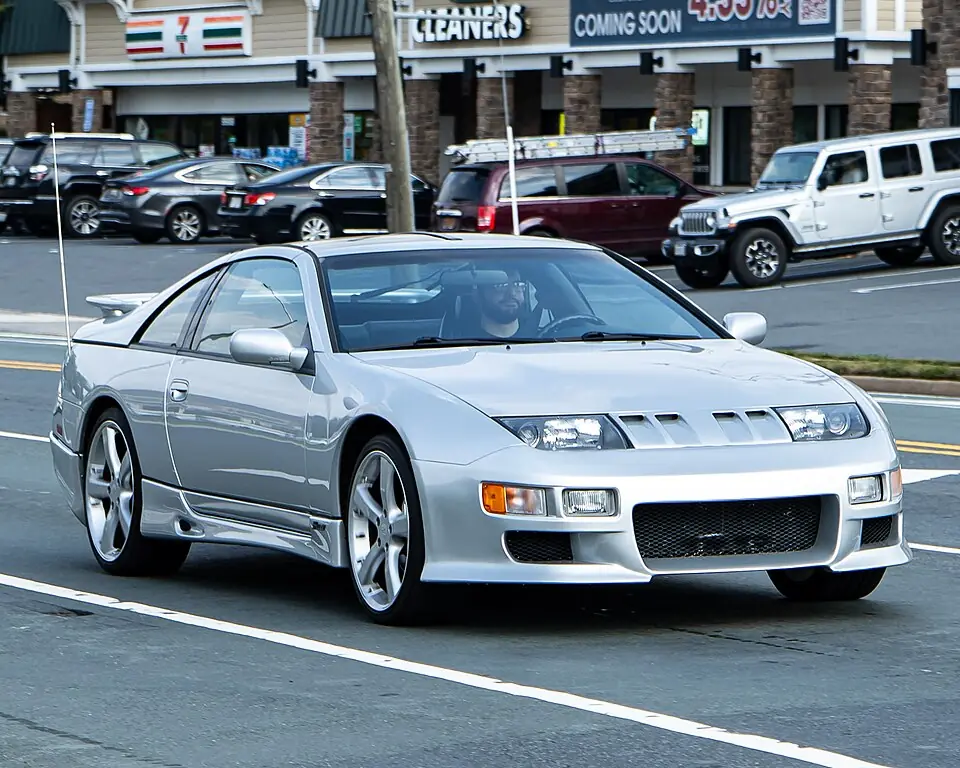
Nissan 300ZX (Z32)
Why 4.8: Japan's bubble-era tech statement — twin turbos, four-wheel steer, a cockpit from a fighter jet. Survivors are thinning into collections while the faithful keep the rest running.
Layout
Natural habitat
Ride comfort
Sound
The VG30DETT has a smooth deep V6 undertone and audible turbo whoosh once boost arrives. But Nissan built this as a technology flagship and insulated it to match: the exhaust is quiet and the note never hardens. It has aged into respect for everything except this.
6-cylinder · turbocharged · 7,000 rpm redline · rated 4.9 / 10 for engine sound
Market value
Median asking price, good condition · €11k (2000) → €32k (2026), trending up · illustrative data
Child seats · ISOFIX
There aren't any — strict two-seater.
300ZX sales ended in 1996 in the US, three years before ISO 13216-1 (the ISOFIX lower-anchor standard) was even published in 1999 — there was no compliant hardware on the market yet to fit.
Nissan sold a dedicated lap-belt child-restraint accessory for the Z32 — worth knowing because the factory belts are door-mounted, which otherwise makes a normal child-seat install nearly impossible.
Wikipedia (ISOFIX: ISO 13216-1 published 1999) + Nissan 300ZX US/Europe sales window (owner-community sourced, not manufacturer documentation)
The long version
The twin-turbo VG30DETT was Japan's bubble-economy flex made real, four-wheel steering and pop-up headlights included, and it takes a specific kind of owner to keep that complexity running thirty-plus years later without a factory parts department behind it. That's split the surviving population cleanly: unmolested TTs are getting bought up and preserved as artifacts of peak-90s Nissan ambition, while the rest stay with enthusiasts sourcing parts from overseas and driving them because the alternative is losing the car entirely. Values have climbed steadily as the collector half of that equation grows, but the daily-tinkerer half hasn't gone anywhere.