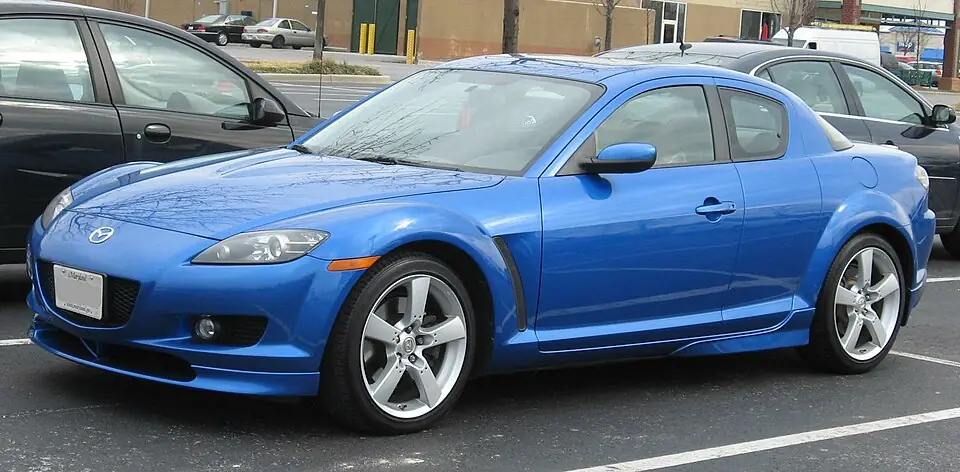
Mazda RX-8
Why 7.3: A 9,000 rpm rotary for used-hatchback money — ownership as commitment. Nobody speculates on a car that needs a rebuild fund; everybody left drives it.
Layout
Natural habitat
Ride comfort
Sound
The Renesis twin-rotor has no reciprocating thrash at all, just a smooth rising buzz-saw to 9,000 rpm that no piston engine imitates. But side exhaust ports make it thinner than the turbo 13B, and it drones flatly at a cruise. Distinctive enough to clear every four-cylinder here.
2-cylinder · rotary · 9,000 rpm redline · rated 7.6 / 10 for engine sound
Market value
Median asking price, good condition · €20k (2005) → €13k (2026), trending down · illustrative data
Child seats · ISOFIX
Both rear seats get LATCH lower anchors — "both anchors must be used" — plus tether anchor points. Mazda built the RX-8 as a genuine 4-seater with rear-hinged "freestyle" doors, not a token 2+2.
The owner's manual is explicit: "the LATCH child-restraint system cannot be secured in the front passenger's seat and should be used in the rear seat." A forward-facing restraint can go up front via the seatbelt only, as a last resort.
The 2004 manual documents seat-belt buckle switches and a driver-seat slide-position sensor feeding the airbag system, but nothing describing a dedicated passenger-seat cutoff switch or full occupant-classification shutoff.
2004 Mazda RX-8 US owner's manual
The long version
You don't end up owning an RX-8 by accident — everyone who has one went in with eyes open about apex seals, oil consumption, and a rebuild that's a matter of when, not if, which filters out anyone buying for status. What's left is a community that treats the maintenance as tuition rather than a deterrent, and drives the thing to redline because that's the only way a rotary makes sense. Values cratered hard in the 2010s and have only partly recovered, which keeps the ownership pool self-selected for people who want the singing redline badly enough to accept the consequences.