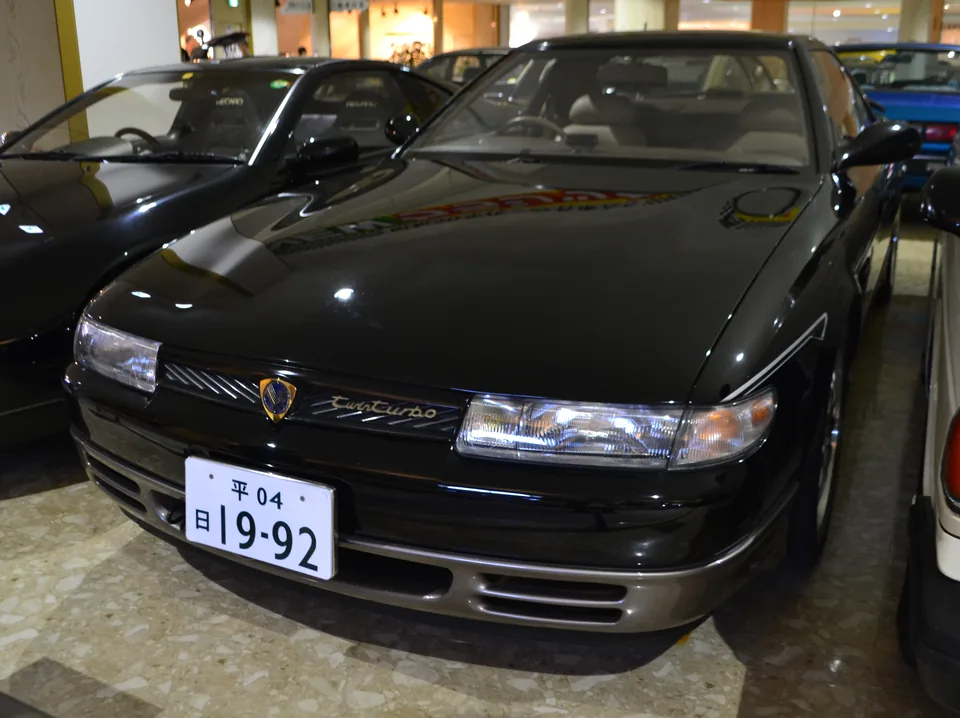
Mazda Eunos Cosmo
Why 5.7: The 20B-REW is the only three-rotor engine ever fitted to a production car, and the Eunos Cosmo is the only car it went into. Mazda gave it 280 PS, 403 Nm and the first factory-fitted GPS navigation screen in any production car — then made an automatic gearbox the sole option.
Layout
Natural habitat
Ride comfort
Sound
The only three-rotor production engine ever sold, and the 20B spins with a smoothness and hard rotary buzz nothing with pistons produces. But two turbochargers and a luxury GT's insulation mute it, and the drone wears at a cruise.
3-cylinder · rotary · 7,000 rpm redline · rated 7.0 / 10 for engine sound
Market value
Median asking price, good condition · €48k (1990) → €51k (2026), trending up · illustrative data
Child seats · ISOFIX
Built before ISOFIX existed, so there are no anchor points at all. A child seat here is a seatbelt installation, and the belt geometry of the period was not designed with one in mind.
Derived from production years and seating layout, not a per-car source. ISOFIX was standardised as ISO 13216 in 1997, required on new EU model types from 2011 and on all new EU cars from 2014.
The long version
Mazda launched the JC Cosmo at the very top of the bubble as a two-door luxury coupe with a choice of twin-turbocharged rotaries: the 13B-RE two-rotor or the 20B-REW three-rotor, the latter making 280 PS under the Japanese gentlemen's agreement and 403 Nm of torque, which is the figure that actually describes how it drives. The top Type E CCS carried a colour touchscreen with built-in satellite navigation in 1990, years before anyone else managed it. Only 8,875 Cosmos were built in five and a half years and roughly 40 per cent took the 20B, so the three-rotor car is rare twice over — and no owner can ever shift one themselves, because Mazda never offered a manual in any market. That single decision shapes everything: nobody tracks a Cosmo, nobody covers big distances in one at the fuel consumption a triple-rotor implies, and it is bought almost exclusively by rotary people who wanted the engine that exists nowhere else. Values sat near scrap for a decade after the bubble burst and have climbed steadily since Japanese imports became fashionable, but the cars stay with the same owners for years, because there is no second Cosmo to move up to.