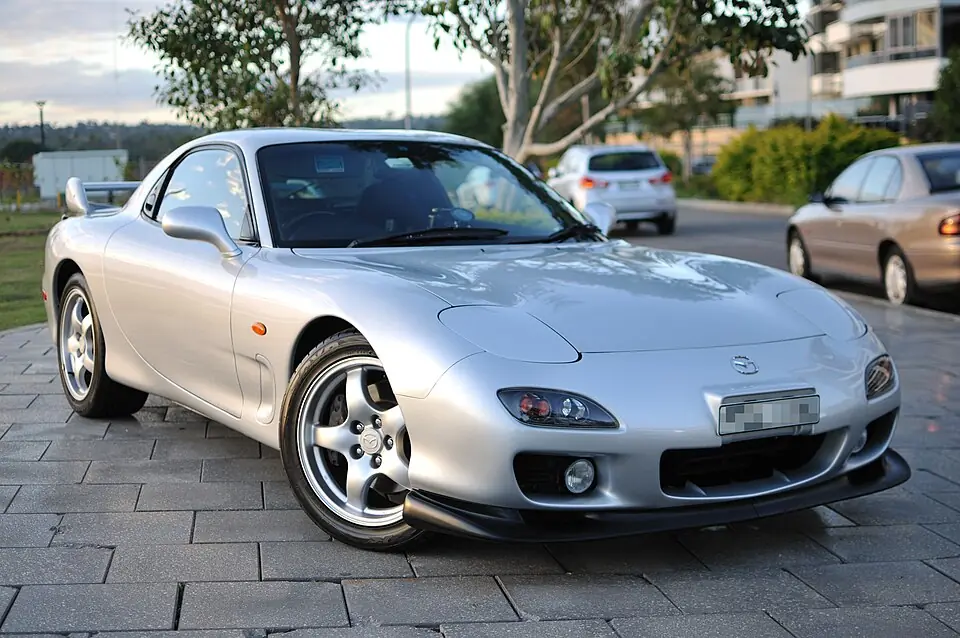
Mazda RX-7 (FD)
Why 6.3: A 1.3-litre rotary that demands premix, patience and revs — nobody owns one by accident. Values climbed, but the community still drives and tracks them.
Layout
Natural habitat
Ride comfort
Sound
The 13B-REW has no reciprocating pulse at all, just a hard even rasp that spins past 8,000 without ever sounding strained, and nothing with pistons replicates it. The sequential turbos take the edge off, and at a steady motorway cruise the drone is relentless.
2-cylinder · rotary · 8,000 rpm redline · rated 7.8 / 10 for engine sound
Market value
Median asking price, good condition · €18k (2000) → €74k (2026), trending up · illustrative data
Child seats · ISOFIX
There aren't any — strict two-seater.
US-market FD RX-7 sales ran only 1993-1995, years before ISO 13216-1 was published in 1999 — there was no ISOFIX hardware on the market yet for Mazda to fit.
Japan-spec cars offered a token 2+2 rear bench for insurance/tax classification purposes — cramped enough that most cars shipped with a blanking panel instead.
Wikipedia (ISOFIX: ISO 13216-1 published 1999) + Mazda RX-7 US sales window (1993-1995) (owner-community sourced, not manufacturer documentation)
The long version
Owning a rotary is a standing commitment, apex seals, premix, a fuel bill that punishes hesitation, so nobody ends up with an FD by accident or as a passive investment; the maintenance alone filters out anyone who is not planning to drive it. Values have quadrupled since 2000, mostly in the last decade, and yet the drift and track-day scene around this chassis has not thinned out the way six-figure JDM icons usually do. No badges here mostly because it sits in the honest middle: driven enough to avoid Garage Queen, still occasionally flipped by people chasing the rotary hype rather than the rotary experience.