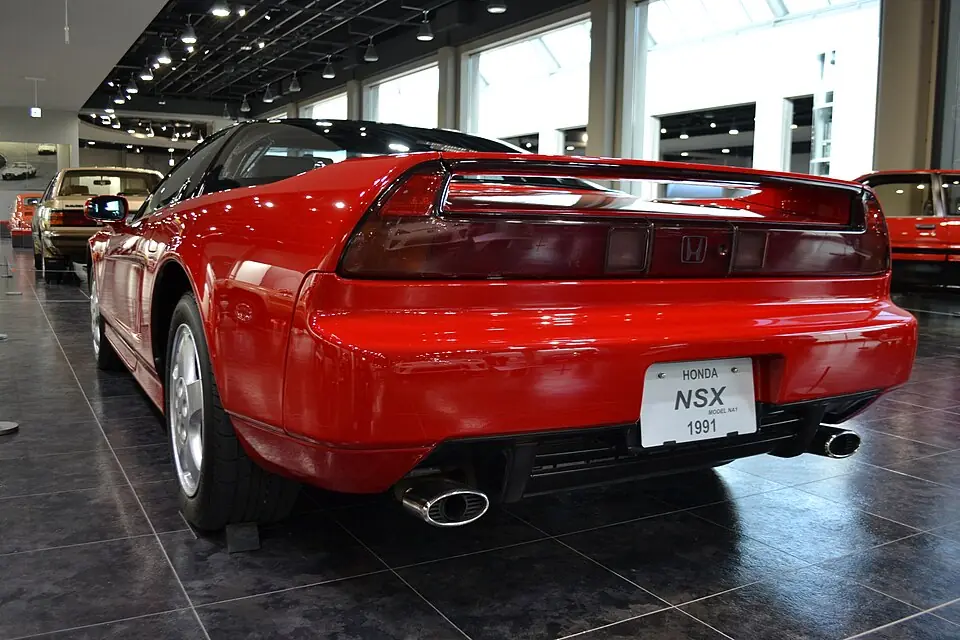
Honda NSX (NA1)
Why 5.8: Senna-tuned precision with Civic-grade reliability — the everyday-supercar promise, mostly kept. Collector money arrived late; a healthy share still get driven the way Honda intended.
Layout
Natural habitat
Ride comfort
Sound
The C30A changes voice as VTEC opens near 5,800 and hardens all the way to 8,000 rpm, a foot behind your shoulders. But Honda deliberately insulated the NSX for daily use, so it is a quieter and more contained noise than the mid-engined Italians it was aimed at.
6-cylinder · naturally aspirated · 8,000 rpm redline · rated 8.3 / 10 for engine sound
Market value
Median asking price, good condition · €46k (2000) → €138k (2026), trending up · illustrative data
Child seats · ISOFIX
There aren't any — strict two-seater.
Owner's manual (2005 model year, covering the closing years of NA1/NA2 production) states the car "does not have a back seat" and recommends against carrying any child not mature enough to ride up front — no ISOFIX/LATCH terminology appears anywhere in the manual, only lap/shoulder belts.
Checked the 2005 model-year manual specifically because it's the newest NA-chassis year and thus likeliest to have picked up ISOFIX if Honda ever added it; it hadn't. No on/off switch for the passenger airbag either.
2005 Acura NSX Owner's Manual (official, techinfo.honda.com)
The long version
For most of its life this was just a used sports car; values sat flat to declining through the 2000s while owners drove them like the Hondas they mechanically are, oil changes and all. Collector attention arrived over a decade late, roughly doubling values since 2016, and it has caught a chunk of the fleet mid-ownership rather than at the point of sale, so plenty of NSXs are still being driven by people who bought them before anyone called it an investment. F1 DNA nods to Senna's chassis input, but the real story is a supercar that spent twenty years failing to act like one.