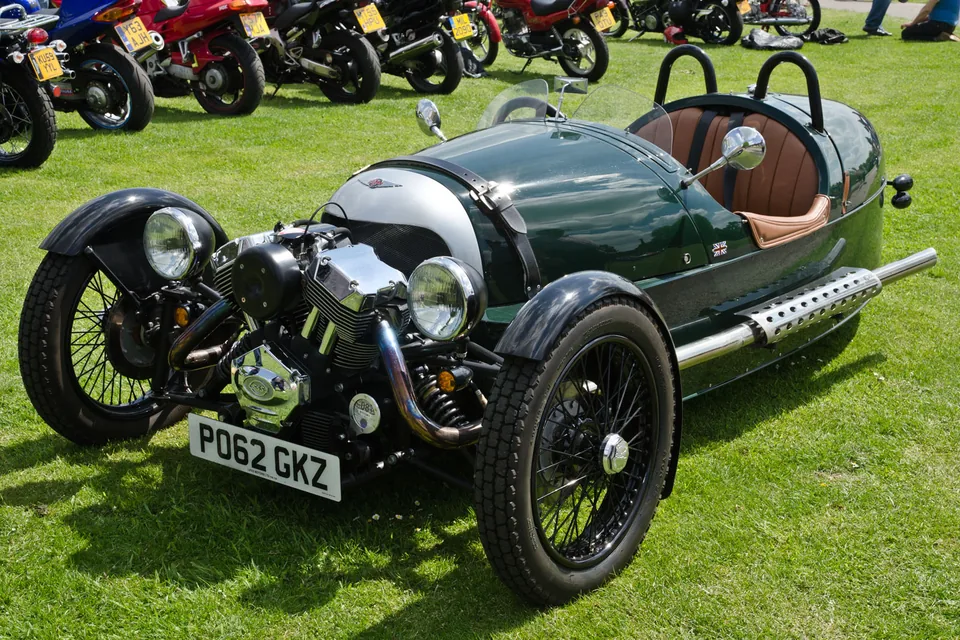
Morgan 3-Wheeler
Why 6.2: An S&S 1,983 cc air-cooled V-twin bolted to the outside of the car ahead of the front axle, a five-speed gearbox out of a Mazda MX-5, and a toothed belt driving the single rear wheel. 550 kg, no roof, no airbags, no traction control, and in the United States it is registered as a motorcycle.
Layout
Natural habitat
Ride comfort
Sound
The S&S twin is bolted to the outside of the car ahead of the front axle with nothing covering it, so the off-beat 56-degree thump reaches you through open air rather than bodywork. But it is two air-cooled pushrod cylinders finished by 5,250 rpm, with no crescendo and nowhere to build. Theatre, not range.
2-cylinder · naturally aspirated · 5,250 rpm redline · rated 7.0 / 10 for engine sound
Market value
Median asking price, good condition · €41k (2012) → €42k (2026), trending up · illustrative data
Child seats · ISOFIX
There aren't any — strict two-seater.
No anchors, and on most of these no passenger airbag either — the car is too stripped for the question to arise. Whatever goes in that seat goes in on a harness or a belt.
Derived from production years and seating layout, not a per-car source. ISOFIX was standardised as ISO 13216 in 1997, required on new EU model types from 2011 and on all new EU cars from 2014.
The long version
Morgan stopped building three-wheelers in 1952 and restarted in 2011 with a car that is not a tribute so much as a straight continuation. The engine is a Harley-sized American V-twin sitting completely uncovered in the airflow, the gearbox came from Mazda, and the drive to the single rear wheel goes through a belt. About 850 deposits were taken before the first customer car was handed over in Europe in February 2012, with the United States following in June — and the American cars sidestepped every crash and emissions requirement that applies to a car, because they were homologated as motorcycles. That is the most useful fact about it: the legal system does not think this is a car, and neither will you after a mile. Performance is beside the point and the published figures disagree with each other anyway — evo timed the sprint to 62 mph at a little over six seconds, which is honest, and other sources quote numbers that are not. What it does have is 550 kg, sightlines over an engine that is visibly doing the work, and steering through sliding pillars that dates conceptually to before the war. Morgan ran it to 2021 and closed it out with the P101 before replacing it with the water-cooled Super 3. Values barely moved across the whole production run, which is unusual and says something: nobody bought one to sell it, because there was never a moment when this looked like a sensible asset.