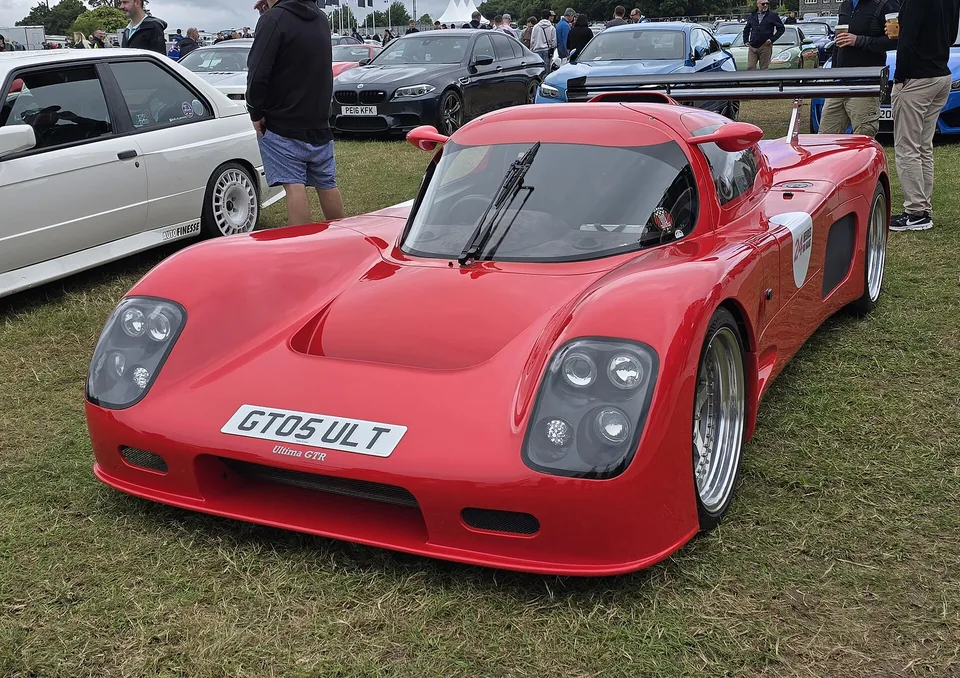
Ultima GTR
Why 6.8: A tubular steel spaceframe with glassfibre panels, a Chevrolet small-block behind the cabin and a Porsche transaxle behind that, at around 1,000 kg. Sold as a kit or turnkey until 2015, with the engine specification largely up to whoever was writing the cheque.
Layout
Natural habitat
Ride comfort
Sound
A big American V8 sits in an open tubular frame under a glassfibre shell with no insulation anywhere, about as unmediated as a road-legal pushrod eight gets. But the exact noise depends on which block the owner bought and how hard it was tuned, and a two-valve V8 is done by 6,500 rpm. Ferocious, not a melody.
8-cylinder · naturally aspirated · 6,500 rpm redline · rated 7.5 / 10 for engine sound
Market value
Median asking price, good condition · €55k (2005) → €63k (2026), trending up · illustrative data
Child seats · ISOFIX
There aren't any — strict two-seater.
The only position there is — and the weak point of this era. Airbag cut-off switches only became routine in the mid-2000s; many of these cars have none from the factory, which rules out a rear-facing seat entirely unless a dealer-fitted deactivation was installed. Forward-facing on the belt, seat slid fully back, is what the period manuals allow.
Derived from production years and seating layout, not a per-car source. ISOFIX was standardised as ISO 13216 in 1997, required on new EU model types from 2011 and on all new EU cars from 2014.
The long version
Before it was a road car with records, the Ultima was a component the McLaren F1 was built on. In 1991 the TAG McLaren Group bought two Ultima Mk3 kits from Lee Noble's Noble Motorsport and named them Albert and Edward: Albert ran a Chevrolet V8 standing in for the BMW V12's torque while McLaren developed the gearbox and the central driving position, and Edward received the very first BMW S70/2 in March 1992 to prove the cooling and the exhaust. Both were crushed when McLaren finished with them. What Ultima did next was keep selling essentially the same idea to the public, and the GTR from 1999 is the mature version of it — spaceframe, glassfibre, Porsche G50 and later G52 transaxle, butterfly doors, and a Chevrolet V8 anywhere from 345 to 720 bhp depending on what the customer ordered. In 2006 the 720 bhp car went record-hunting and came back with 0–60 mph in 2.6 seconds, 0–100 in 5.3, a 0–100–0 in 9.4 and 100–0 mph in 3.6 seconds, numbers that embarrassed cars costing ten times as much. The ownership pattern is unlike anything else on this list: most of these were assembled by the person who then drove them, which makes flipping close to meaningless and track use close to universal. Road miles are low, paddock miles are not, and the market has never behaved like a market.