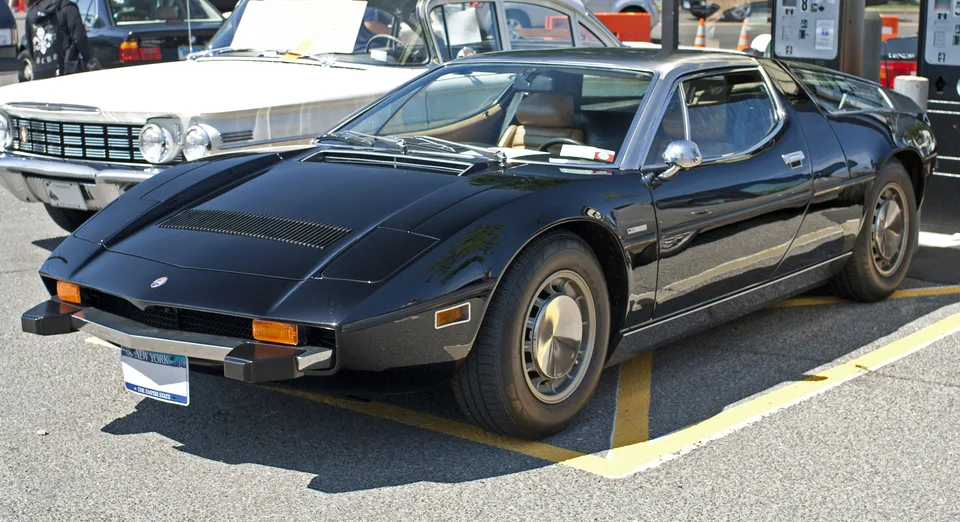
Maserati Bora
Why 3.3: Maserati's first mid-engine road car and first steel unibody, styled by Giugiaro, with Citroën-sourced hydraulics running the brakes, pop-up headlights, driver's seat and an adjustable pedal box. It traded for used-Camry money through most of the 2000s, and only 524 were built — the ownership pattern is only now catching up to the rarity.
Layout
Natural habitat
Ride comfort
Sound
The quad-cam Maserati V8 on Webers has a deep, gruff bark no Ferrari V8 shares. It is capped by the glass bulkhead and Citroen-era insulation Maserati fitted deliberately to make this a quiet GT — a great engine held at arm's length from the driver.
8-cylinder · naturally aspirated · 6,500 rpm redline · rated 7.6 / 10 for engine sound
Market value
Median asking price, good condition · €26k (1974) → €133k (2026), trending up · illustrative data
Child seats · ISOFIX
Built before ISOFIX existed, so there are no anchor points at all. A child seat here is a seatbelt installation in the only passenger seat there is.
Derived from production years and seating layout, not a per-car source. ISOFIX was standardised as ISO 13216 in 1997, required on new EU model types from 2011 and on all new EU cars from 2014.
The long version
Citroën owned Maserati when this was developed, and it shows in ways no other Italian exotic of the era can match: the brakes, the pop-up headlights, the driver's seat position and a pedal assembly that slides backward and forward are all run off the same hydraulic system Citroën used in the SM and the DS, an elegant idea in period that today makes Bora ownership as much about finding a hydraulics specialist as a Maserati one. Underneath the Citroën plumbing is a genuine mid-engine first for the brand — Maserati's first unit-body chassis, replacing the tube frames of the front-engine Ghibli and Quattroporte — styled by Giorgetto Giugiaro at Italdesign into one of the cleaner wedges of the era. Only 524 were built across the run, 289 with the 4.7-liter V8 and 235 with the stroked 4.9 fitted mainly to US-bound cars from 1973 onward. That rarity did nothing for values for three decades; clean examples traded for used-family-car money well into the 2000s, overshadowed by Ferrari's contemporary mid-engine V12 and by Maserati's own better-known Ghibli. Recent sales have finally caught up — good 4.9s now clear well over $100,000 — but the split in the current market, rough examples still finding buyers under $10,000 against clean ones pushing six figures, shows how much of the fleet is still driven by people who bought in before anyone else noticed.