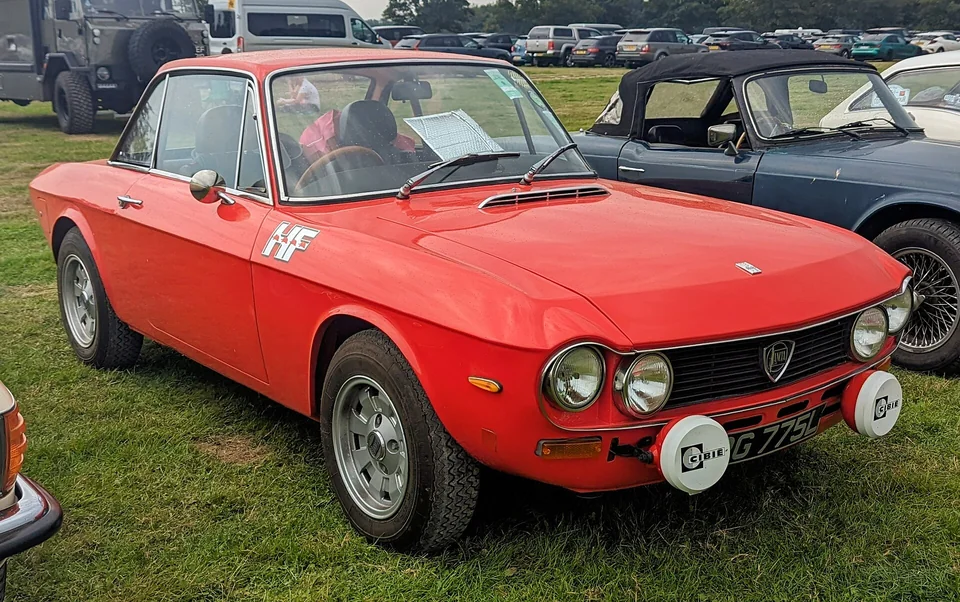
Lancia Fulvia HF
Why 4.3: A narrow-angle V4 mounted ahead of the front axle over a transaxle is an unpromising way to build a rally car, and it did not stop the Fulvia taking the RAC Rally in 1969 and 1970 and the Monte Carlo outright in 1972. The HF versions went on public sale purely to homologate rally parts; 1,258 of the definitive 1.6 were built.
Layout
Natural habitat
Ride comfort
Sound
The 13-degree narrow-angle V4 runs a single cylinder head and twin carburettors, giving a hard off-beat rasp no inline four produces. But 1.6 litres and 6,500 rpm cap the depth, so it is a genuinely unusual noise rather than a big one.
4-cylinder · naturally aspirated · 6,500 rpm redline · rated 7.4 / 10 for engine sound
Market value
Median asking price, good condition · €4k (1970) → €152k (2026), trending up · illustrative data
Child seats · ISOFIX
Built before ISOFIX existed, so there are no anchor points at all. A child seat here is a seatbelt installation, and the belt geometry of the period was not designed with one in mind.
Derived from production years and seating layout, not a per-car source. ISOFIX was standardised as ISO 13216 in 1997, required on new EU model types from 2011 and on all new EU cars from 2014.
The long version
The Fulvia HF is a homologation car in the most literal sense — Lancia put the hot versions on sale to the general public specifically so the improvements could be homologated for the works rally team, which is why the road cars carry aluminium panels, Plexiglas side windows and equipment lists that read as a series of deletions. The engineering is unusual even by Italian standards: a narrow-angle V4 with both banks under a single head, mounted ahead of the front axle and driving the front wheels through a transaxle. On paper 115 CV should not have been enough for anything, but at 850 kg on the right surface it plainly was, and the Fulvia won the RAC Rally in 1969 and 1970 before Sandro Munari took the Monte Carlo Rally outright in 1972. Only 1,258 of the 1.6-litre HF were built for homologation, plus a small run of works chassis, and Lancia had no official presence in the United States during the Fulvia's life, so every American car arrived privately. Values reflect all of it: a Fulvia HF has not been a cheap car since the 1990s. What use these still get is almost entirely historic rallying and regularity events rather than ordinary driving, which is why the ownership score sits where it does despite everything the car is.