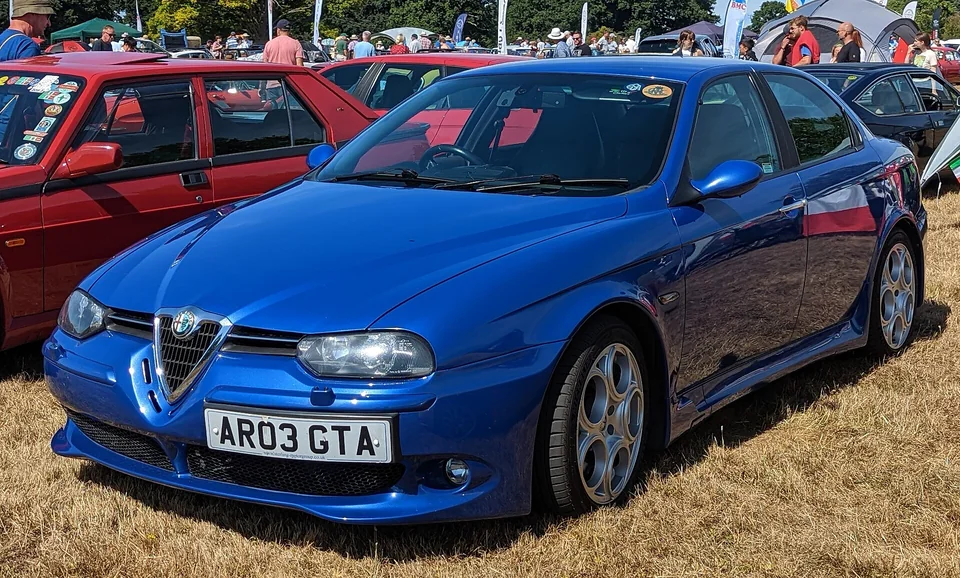
Alfa Romeo 156 GTA
Why 6.1: The same 3.2-litre Busso as the 147 GTA, in a four-door that also came as an estate — 250 PS and 300 Nm through the front axle, with the torque steer that arrangement guarantees. Only 4,651 were built across both body styles, and the engine's status as the last of the Bussos is quietly pulling the good ones off the road.
Layout
Natural habitat
Ride comfort
Sound
The 3.2 is the largest and hardest-edged Busso, and it howls on induction all the way to the limiter. It is capped by a family saloon's insulation and catalysts softening what the older cars let out raw, which puts it just above the GTV6 rather than clear of it.
6-cylinder · naturally aspirated · 6,200 rpm redline · rated 8.4 / 10 for engine sound
Market value
Median asking price, good condition · €35k (2003) → €26k (2026), trending down · illustrative data
Child seats · ISOFIX
ISOFIX was spreading through these years rather than fitted across the board — whether a given car has rear anchors depends on its year and market.
Children were expected in the back. Front-passenger ISOFIX effectively didn't exist in this era, and airbag deactivation was patchy — treat the front seat as a no unless a specific car proves otherwise.
Derived from production years and seating layout, not a per-car source. ISOFIX was standardised as ISO 13216 in 1997, required on new EU model types from 2011 and on all new EU cars from 2014.
The long version
Alfa's answer to the fast-saloon question in 2002 was to take the 3.2-litre Busso V6 — an engine conceived for longitudinal, rear-drive installations — mount it transversely in the 156's nose and send 250 PS to the front wheels, with wider tracks, bigger brakes and blistered arches to cope with the consequences. It is not a clean-handling car by modern standards and was never trying to be; the appeal is the noise and the way the engine keeps pulling long after a turbocharged rival has lost interest. Alfa Romeo had already left the American market in 1995, so the 156 never had a US chapter at all. Just 2,973 saloons and 1,678 Sportwagons were built in three years, and while values fell to almost nothing through the early 2010s the way every complicated used Alfa's do, they have climbed steadily since — driven less by the car itself than by the growing understanding that emissions rules killed the Busso and nothing replaced it. The Sportwagon has become the connoisseur's pick, and the honest problem now is that a rising share of the best cars have stopped being used at all.