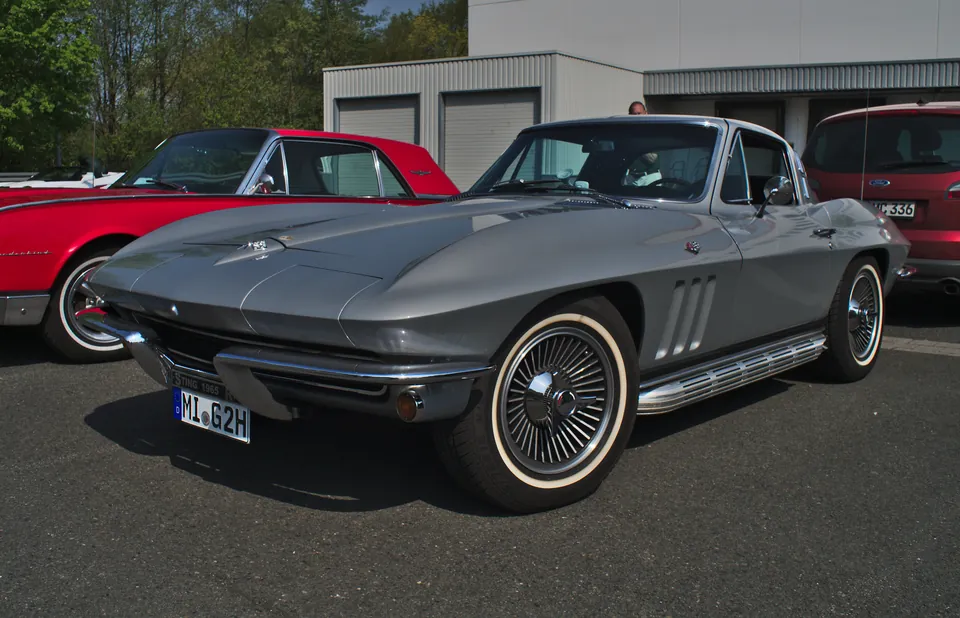
Chevrolet Corvette Sting Ray (C2)
Why 4.0: Zora Arkus-Duntov finally got independent rear suspension under a Corvette, and Bill Mitchell's studio wrapped it in the body that fixed the car's identity for good. Sixty years on, split-window coupes and documented big-blocks are auction furniture, and even an ordinary 327 costs enough that most arrive at shows on a trailer.
Layout
Natural habitat
Ride comfort
Sound
Solid lifters, a big four-barrel and the optional side exhaust exiting beneath the door make this one of the definitive American V8 noises, unsilenced in the literal sense. It is capped by 6,200 rpm and one register: a hard bark, held, with nowhere to climb.
8-cylinder · naturally aspirated · 6,200 rpm redline · rated 7.6 / 10 for engine sound
Market value
Median asking price, good condition · €5k (1965) → €87k (2026), trending up · illustrative data
Child seats · ISOFIX
Built before ISOFIX existed, so there are no anchor points at all. A child seat here is a seatbelt installation in the only passenger seat there is.
Derived from production years and seating layout, not a per-car source. ISOFIX was standardised as ISO 13216 in 1997, required on new EU model types from 2011 and on all new EU cars from 2014.
The long version
The C2 is where the Corvette stopped being a boulevard car with a V8 in it. Duntov's independent rear suspension arrived for 1963 — a transverse leaf on trailing arms, crude next to a Jaguar but transformative next to the live axle it replaced — beneath a body derived from Mitchell's Stingray racer, with hidden headlamps and, for 1963 only, the split rear window that Duntov argued against and everyone has coveted since. Engines began with a 250 hp 327 and climbed through the fuel-injected 360 hp version to the 396 in 1965 and the 427 in 1966, topping out at a nominal 435 hp. Just under 118,000 were built in five years, which is a great many cars, and for two decades they were cheap enough to be used up. That has stopped. Split-windows and documented big-blocks trade in six figures, and even a plain small-block costs enough that the annual mileage has collapsed. What keeps this off the floor is sheer volume: there are still enough of them that a driver-grade car is an attainable thing to own and use, and the people who own those do use them.