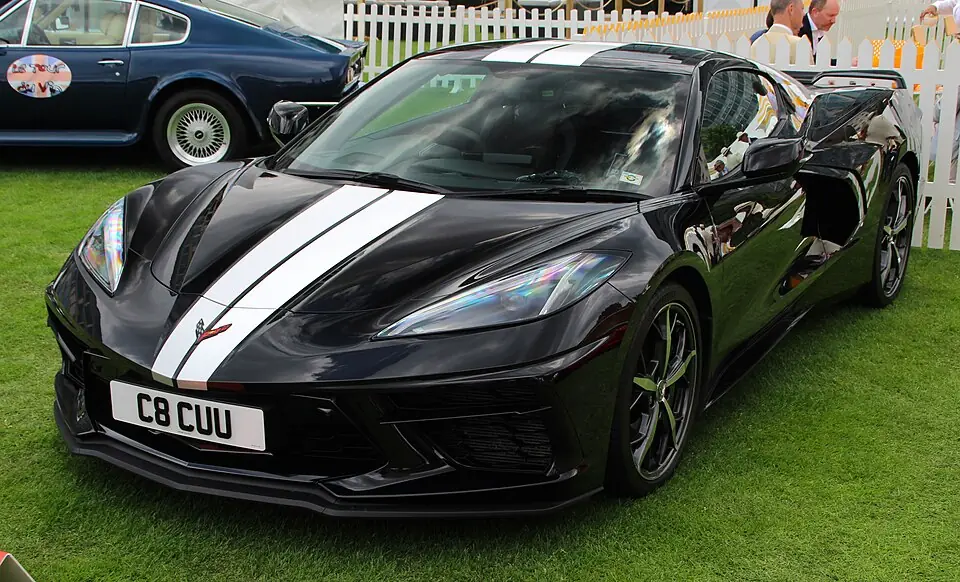
Corvette Stingray (C8)
Why 6.5: Supercar layout at sedan money, and most get genuinely driven — the retiree road-trip Corvette tradition survived the engine moving backwards.
Layout
Natural habitat
Ride comfort
Sound
The pushrod 6.2 LT2 now sits behind your head, so the NPP exhaust's bass arrives in the cabin instead of trailing behind. But 6,500 rpm and two valves per cylinder mean it bellows rather than sings. The best-placed American V8 here, still short of the ones that rev.
8-cylinder · naturally aspirated · 6,500 rpm redline · rated 7.3 / 10 for engine sound
Market value
Median asking price, good condition · €69k (2020) → €53k (2026), trending down · illustrative data
Child seats · ISOFIX
There aren't any — strict two-seater.
The owner's manual spells out the procedure step by step: no LATCH hardware, so it's seatbelt-only, backed by a passenger sensing system that's designed to shut off the airbag when it reads a child restraint.
GM's manual is unambiguous that there's no LATCH hardware at all in this seat — every install is belt-only, by design, not as a workaround.
2020 Chevrolet Corvette Owner's Manual (GM)
The long version
Where the Z06 got eaten alive by markup speculation, the base Stingray mostly avoided that fate — it's still bought by the same generation of buyers who've owned three or four previous Corvette generations and plan to put real miles on this one too. Road-trip culture around the Corvette is older than most of this list and the C8 slots right in, mid-engine layout notwithstanding; the caravan to a car show is still the default use case, not a photo op. Depreciation here tracks like a normal performance car rather than a speculative asset, which fits a buyer base more interested in driving than flipping.