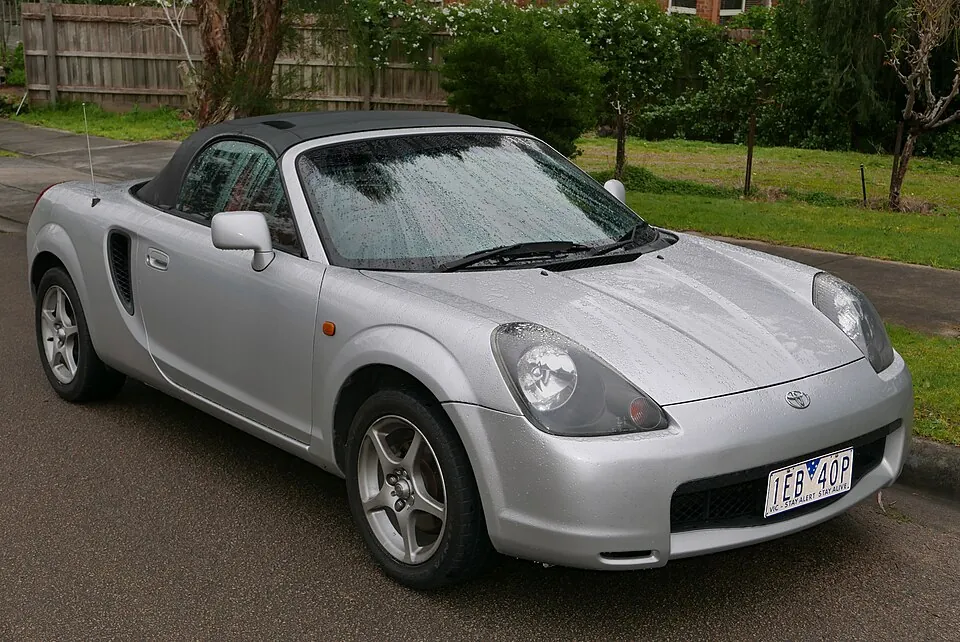
Toyota MR2 Spyder (W30)
Why 8.2: Toyota answered the SW20's reputation for biting by throwing away the turbo, the roof and about 250 kg. What is left is a mid-engined roadster under a tonne with 138 hp and no luggage space at all — the purest thing Toyota built in that decade, and the one everybody underrated because the numbers were small.
Layout
Natural habitat
Ride comfort
Sound
Mid-mounting puts the 1ZZ directly behind your head under a roof that folds away, so you hear everything it does. The trouble is that it is a Corolla engine with no lift cam and no change of character at 6,800 rpm, which makes it audible rather than interesting.
4-cylinder · naturally aspirated · 6,800 rpm redline · rated 4.6 / 10 for engine sound
Market value
Median asking price, good condition · €21k (2000) → €20k (2026), trending down · illustrative data
Child seats · ISOFIX
There aren't any — strict two-seater.
The only position there is — and the weak point of this era. Airbag cut-off switches only became routine in the mid-2000s; many of these cars have none from the factory, which rules out a rear-facing seat entirely unless a dealer-fitted deactivation was installed. Forward-facing on the belt, seat slid fully back, is what the period manuals allow.
Derived from production years and seating layout, not a per-car source. ISOFIX was standardised as ISO 13216 in 1997, required on new EU model types from 2011 and on all new EU cars from 2014.
The long version
The third MR2 is a deliberate rejection of the second. Where the SW20 was heavy, turbocharged and famous for snapping, the W30 is a naturally aspirated 1.8 making 138 hp in a 996 kg roadster, with the engine transverse behind the seats and nothing else anywhere: no boot, no glovebox worth the name, just two small bins behind the headrests. It is genuinely quick only in the way light cars are quick, but the steering is unassisted in feel, the balance is neutral, and it will hold a line at speeds that keep a licence intact. A six-speed manual and a sequential automated gearbox arrived for 2002. Toyota sold it in America from 2000 to 2005 and it never found the audience the numbers deserved — too impractical for a commuter, too slow on paper for anyone cross-shopping a Boxster — so it depreciated to almost nothing and stayed there for a decade. Owners now are a self-selecting group who bought one knowing exactly what it cannot do, which is why so many are still driven year-round and why values have started climbing off the floor.