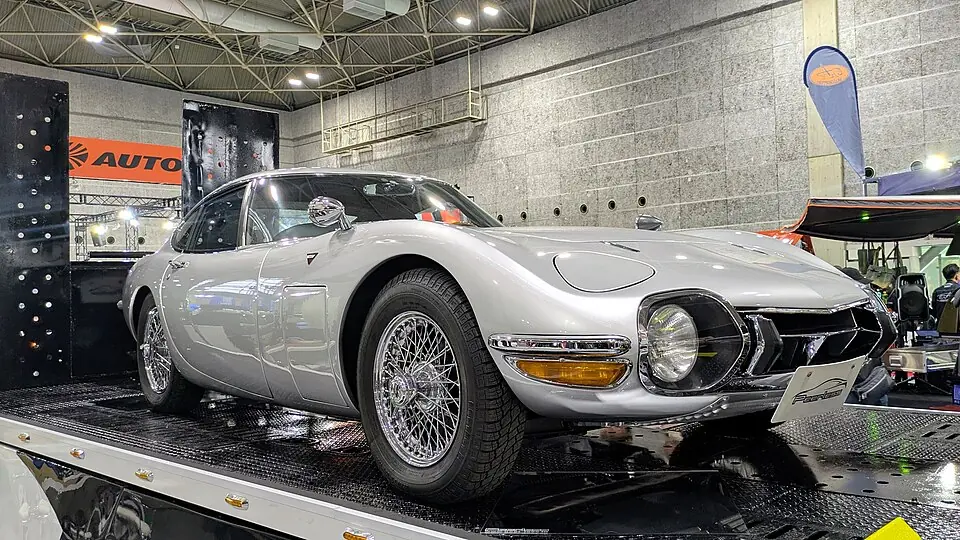
Toyota 2000GT
Why 2.3: Yamaha's twin-cam six is genuinely sweet — free-revving, well-balanced, engineered to prove Japan could build a world-class GT and not just an economy car. Only 351 were built, and with real auction results now well past seven figures, this is the rarest and most valuable car on this shelf; it moves between collections more than it moves under its own power.
Layout
Natural habitat
Ride comfort
Sound
Yamaha's twin-cam head and three Mikuni-Solex 40s give the 2.0 six a clean, hard-edged intake note far more exotic than the Crown block underneath deserves. But it makes 150 hp and stops at 6,600 rpm, tuned for smoothness, so it never reaches the Dino's intensity.
6-cylinder · naturally aspirated · 6,600 rpm redline · rated 7.2 / 10 for engine sound
Market value
Median asking price, good condition · €6k (1967) → €1.2M (2026), trending up · illustrative data
Child seats · ISOFIX
Built before ISOFIX existed, so there are no anchor points at all. A child seat here is a seatbelt installation in the only passenger seat there is.
Derived from production years and seating layout, not a per-car source. ISOFIX was standardised as ISO 13216 in 1997, required on new EU model types from 2011 and on all new EU cars from 2014.
The long version
Toyota built the 2000GT to answer a question nobody had asked yet — can a Japanese manufacturer build a car worthy of sharing a stage with Jaguar and Porsche — and answered it so thoroughly that barely a few dozen ever reached American buyers. That scarcity has only compounded: a 2013 Mecum sale broke the million-dollar mark for a Japanese car for the first time, and prices haven't looked back since. What survives is almost entirely in the hands of serious collectors and museums, insured for sums that make even a slow parade lap a calculated risk. It is, by a wide margin, the least-driven car on this list.