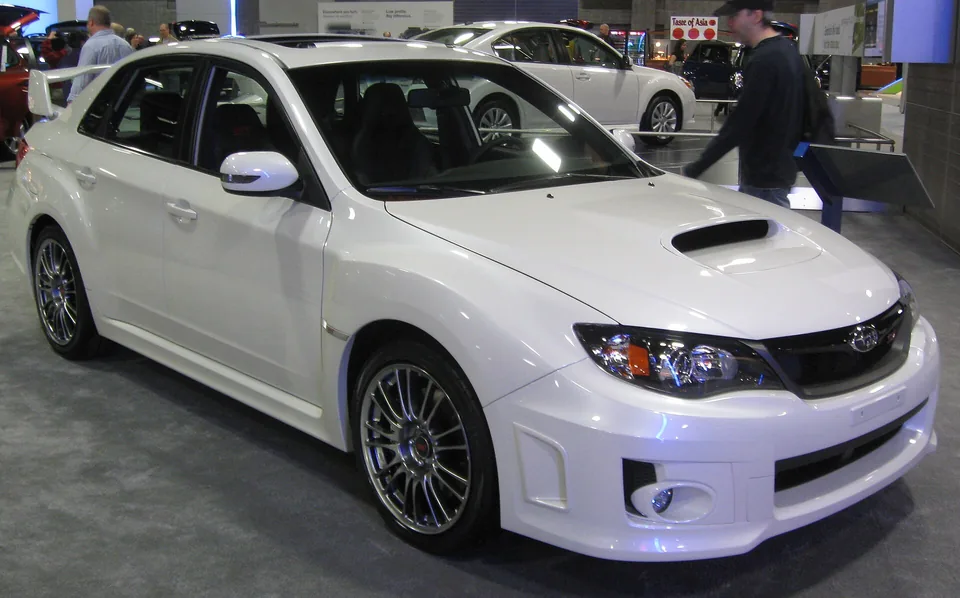
Subaru WRX STI (GVB)
Why 7.3: The 2008 STI was a hatchback with no boot-lid wing and the reaction was unambiguous, so for 2011 Subaru put the saloon back on the widened body with stiffer springs, wider tracks and a wing visible from the car behind. Underneath is the late EJ257: 305 hp, six speeds, Brembos, and a centre differential you bias by thumbwheel. Heavy and slightly numb, and very hard to break.
Layout
Natural habitat
Ride comfort
Sound
The unequal-length headers survive, so the EJ257 still makes the off-beat boxer rumble no other layout produces. But this is the most heavily silenced STI yet — the warble is a suggestion where the GD stated it outright — and boost still flattens everything above 4,500 rpm.
4-cylinder · turbocharged · 6,700 rpm redline · rated 6.1 / 10 for engine sound
Market value
Median asking price, good condition · €31k (2011) → €30k (2026), trending down · illustrative data
Child seats · ISOFIX
Two ISOFIX positions on the outer rear seats, the outer pair being the ones the standard covers.
The rear anchors are the supported route — the manual points child seats there, and front-passenger ISOFIX is the exception rather than the rule. A belt-mounted seat up front needs the airbag off, and cars with a rear row don't always fit a deactivation switch, precisely because the rear seats exist.
Derived from production years and seating layout, not a per-car source. ISOFIX was standardised as ISO 13216 in 1997, required on new EU model types from 2011 and on all new EU cars from 2014.
The long version
Subaru made a genuine misjudgement with the third-generation STI. The 2008 GRB was hatchback-only, soft by STI standards, and it arrived without the boot-lid wing that had been half the appeal for a decade. For 2011 the company answered every complaint at once. The saloon returned as the GVB on the same widened shell as the hatch, with broader tracks front and rear, a lower ride height, stiffer springs and thicker anti-roll bars — and the wing. The EJ257 was left alone at 305 hp, which almost nobody minded, because the point of an STI had never been the peak number. It was the six-speed gearbox, the Brembos, the driver-controlled centre differential, and the reasonable expectation that all of it would still work at 250,000 km. This was also the end of a line: the 2015 VA moved the STI onto a different platform and kept the EJ257 running on borrowed time until it was finally retired. That leaves the GVB at the least valuable point in a car’s life — too new to collect, too old to be a new car — which is the exact window in which cars get used. Rally schools, autocross regulars, long commutes. Very few garages.