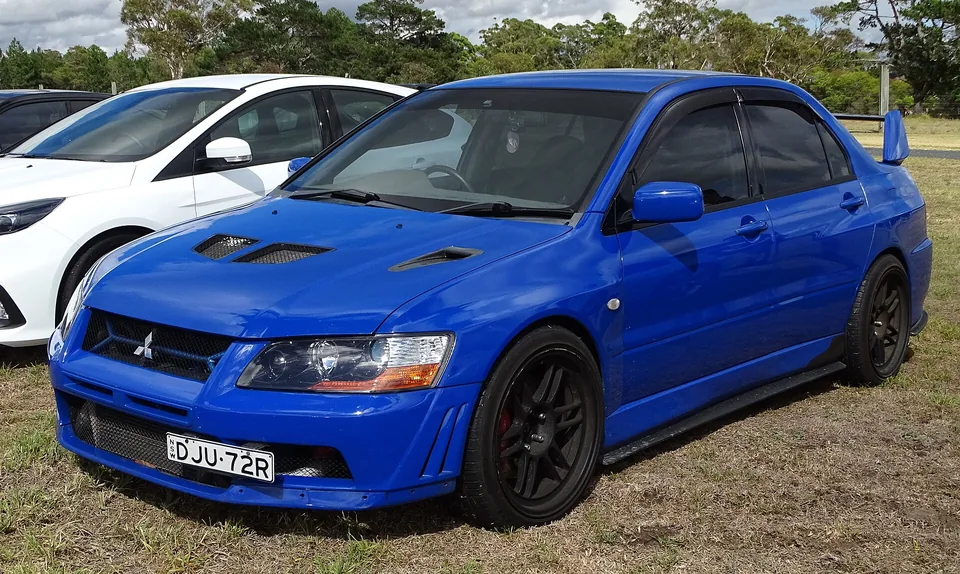
Mitsubishi Lancer Evo VII
Why 6.5: The VII is where Mitsubishi added ACD — an electronically controlled hydraulic centre differential with tarmac, gravel and snow maps — and made it talk to the Active Yaw Control rear diff that had been there since the IV. Two active differentials working together is the whole car. It is also the heaviest Evo built to that point, which is why the purists skip this generation and why you can still afford one.
Layout
Natural habitat
Ride comfort
Sound
The iron-block 4G63 rasps hard and mechanically with spool and dump-valve chatter over it, and the Cedia shell is stiff enough not to blur any of it. But it is the same muffled two-litre four as the Evo VI, with no boxer offbeat to sign it. Level with the generations either side.
4-cylinder · turbocharged · 7,000 rpm redline · rated 5.8 / 10 for engine sound
Market value
Median asking price, good condition · €24k (2001) → €35k (2026), trending up · illustrative data
Child seats · ISOFIX
ISOFIX was spreading through these years rather than fitted across the board — whether a given car has rear anchors depends on its year and market.
Children were expected in the back. Front-passenger ISOFIX effectively didn't exist in this era, and airbag deactivation was patchy — treat the front seat as a no unless a specific car proves otherwise.
Derived from production years and seating layout, not a per-car source. ISOFIX was standardised as ISO 13216 in 1997, required on new EU model types from 2011 and on all new EU cars from 2014.
The long version
The Evo VI Tommi Mäkinen Edition is the one on the posters, so the VII gets filed as the sequel that put on weight. It did put on weight: the Lancer Cedia shell underneath was bigger and stiffer, and the GSR arrived at about 1,400 kg. What Mitsubishi did with that stiffness is the part worth knowing. Active Yaw Control had been shuffling torque across the rear axle since the Evo IV. For the VII the company added an Active Centre Differential — a hydraulic multi-plate clutch under electronic control, with three driver-selectable maps — and then had the two systems work as one. On paper that reads as more electronics between driver and road; in practice the car simply stops running out of front axle. Mitsubishi also finally offered an automatic, the 272 PS GT-A, which sold to people who were never going to rally it and is now both the rarest and the least wanted version. None of this reached America: the Evo VIII in 2003 was the first Mitsubishi shipped there, which is why the VII remains a grey-import curiosity in the market that made the Evo famous. In Japan and Britain it was simply the current Evo, bought new by people who used it, and the odometers still say so.