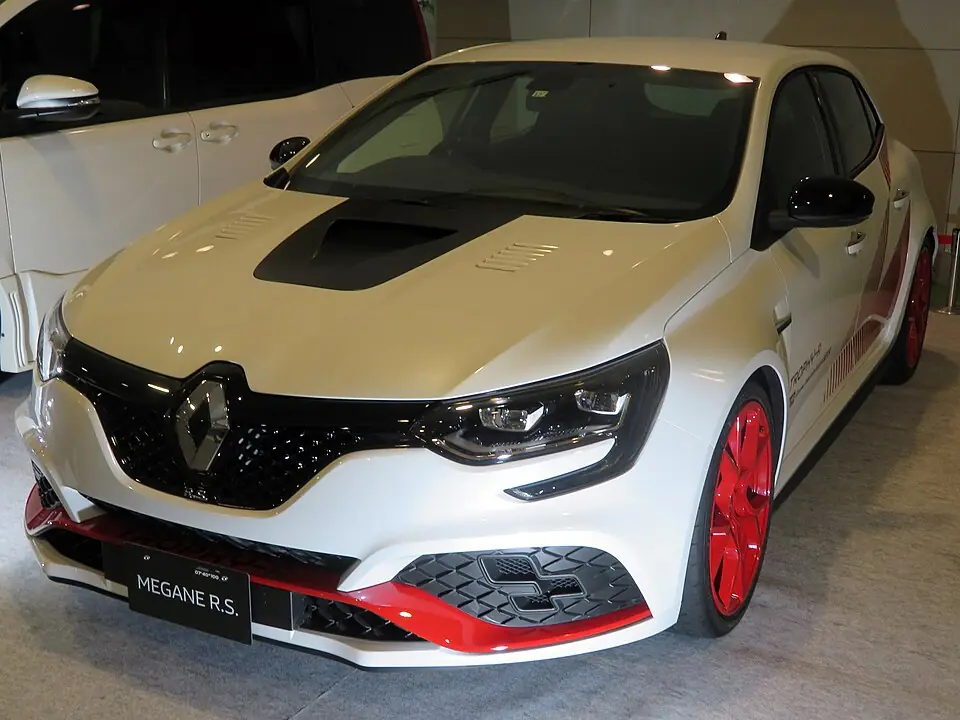
Renault Mégane RS Trophy-R
Why 5.8: Stripped, caged-adjacent, front-wheel-drive only, and the fastest FWD car around the Nürburgring when it launched — a halo hatch built with zero compromise toward comfort or daily practicality. Like the R26.R before it, it never came near a US dealer, and like the R26.R, the ones that exist mostly get tracked, not stored.
Layout
Natural habitat
Ride comfort
Sound
The Akrapovic titanium system is why this one sounds unlike other Méganes: a harder rasp, heavy overrun crackle, and less weight between it and you. But underneath is a 1.8 turbo four stopping at 6,800 rpm, so the exhaust is doing nearly all of the work.
4-cylinder · turbocharged · 6,800 rpm redline · rated 6.0 / 10 for engine sound
Market value
Median asking price, good condition · €60k (2019) → €87k (2026), trending up · illustrative data
Child seats · ISOFIX
There aren't any — strict two-seater.
Fixed-back Sabelt composite-monocoque seats replace the standard chairs; spec coverage of the car is explicit that ISOFIX is a feature of the ordinary 5-seat Mégane RS, not the Trophy-R.
The rear bench is deleted entirely — replaced by a strut brace and a storage cubby — for weight saving, not just stripped of trim.
Carwow / Autocar Mégane RS Trophy-R specification coverage (owner-community sourced, not manufacturer documentation)
The long version
Renault Sport built roughly 500 Trophy-Rs specifically to reclaim the FWD Nürburgring record from the Honda Civic Type R, and buyers who sought out a stripped, four-figure-kilo hot hatch with Öhlins dampers and no rear seats were self-selecting for track use from the outset — this was never a car marketed at comfort-seekers. It never came to the US, extending the same Forbidden Fruit pattern as the Mégane R26.R a generation earlier: American enthusiasts know it entirely through video and import speculation, which has only sharpened demand among the buyers who can actually get one. Values dipped briefly after the initial delivery wave before climbing as the car's Nürburgring pedigree cemented into modern-classic status, mirroring the R26.R's own trajectory a decade on. Öhlins dampers with manual clickers replace any pretense of an adaptive comfort mode, which tells you everything about who Renault built this for and how they're using it.