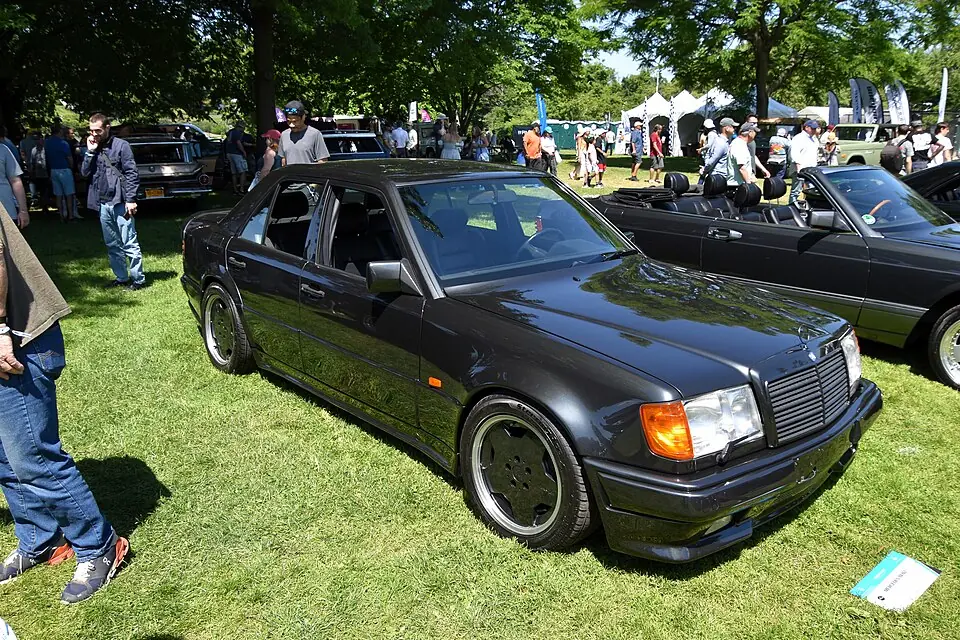
Mercedes-AMG "Hammer" (W124)
Why 3.5: AMG's first V8 swap into a W124 body turned a mid-size Mercedes into a 375hp autobahn missile — the car that built AMG's reputation before Mercedes bought the company. Auction results now clear $600k+; nobody who owns one drives it to the shops.
Layout
Natural habitat
Ride comfort
Sound
AMG's twin-cam conversion of the 6.0 M117 gives a deep, cammy idle and a hard bark under load, with none of the insulation a modern Mercedes carries. It stops at 6,000 rpm, so it thumps rather than climbs — old-school V8 presence rather than a singer.
8-cylinder · naturally aspirated · 6,000 rpm redline · rated 7.5 / 10 for engine sound
Market value
Median asking price, good condition · €172k (1987) → €552k (2026), trending up · illustrative data
Child seats · ISOFIX
Built before ISOFIX existed, so there are no anchor points at all. A child seat here is a seatbelt installation, and the belt geometry of the period was not designed with one in mind.
Derived from production years and seating layout, not a per-car source. ISOFIX was standardised as ISO 13216 in 1997, required on new EU model types from 2011 and on all new EU cars from 2014.
The long version
AMG built the Hammer by hand before AMG was a Mercedes subsidiary, stuffing a 5.6 or 6.0-litre V8 pulled from the S-Class parts bin into a 300E body and selling it through AMG's own network rather than a Mercedes dealer. Only a few dozen were built worldwide, roughly a dozen for the US, which means the ownership pool today is almost entirely museum-adjacent collectors rather than drivers. Auction results have gone from six figures to north of $700,000 in the last five years, a curve that took an unassuming Q-ship sedan and turned it into a vault asset. The car that proved a torquey V8 in an anonymous body could out-drag a Porsche now mostly proves how fast collector money can find an origin story.