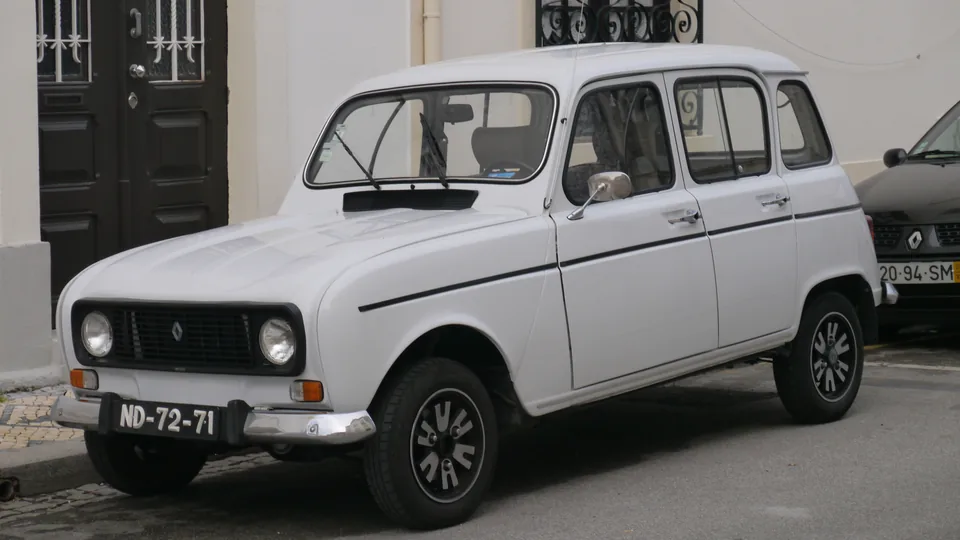
Renault 4
Why 8.6: The world's first mass-produced hatchback, built for thirty-three years across twenty factories on four continents and sold to more than eight million people who mostly needed to move things. Front-wheel drive, torsion-bar suspension, sealed-for-life coolant and a gearchange that comes out of the dashboard on a rod.
Layout
Natural habitat
Ride comfort
Sound
The Cléon-Fonte pushrod four is a genuinely agricultural noise, and in 730 kg with a flat floor and a gearchange rod running back from the dashboard you hear all of it plus the linkage rattling. But 34 hp asked to move a car for thirty-three years makes effort, not tone, and it is done by 5,000 rpm. Never musical.
4-cylinder · naturally aspirated · 5,000 rpm redline · rated 4.2 / 10 for engine sound
Market value
Median asking price, good condition · €5k (1980) → €12k (2026), trending up · illustrative data
Child seats · ISOFIX
Built before ISOFIX existed, so there are no anchor points at all. A child seat here is a seatbelt installation, and the belt geometry of the period was not designed with one in mind.
Derived from production years and seating layout, not a per-car source. ISOFIX was standardised as ISO 13216 in 1997, required on new EU model types from 2011 and on all new EU cars from 2014.
The long version
Renault's brief for the 4 was a car for everybody — farmers, priests, postmen, students, the French state — and the engineering follows from that with total consistency. The rear torsion bars sit one behind the other rather than side by side, which is simple and cheap and leaves the car with a wheelbase about 50 mm longer on the right than the left, a fact Renault never bothered to hide. The gearlever comes horizontally out of the dashboard so that the floor stays flat and three people can sit across the front. The cooling system was sealed and filled with antifreeze for life at a time when topping up the radiator was a weekly ritual. The boot has a proper hatchback lid, which nobody had done on a mass-market car before. None of this was styling; all of it was arithmetic. Production ran from 1961 to 1994 and passed eight million, putting it among the handful of best-selling cars ever made, and its second and third lives — in Spain, Portugal, Morocco, Colombia, Slovenia and across West Africa — lasted decades longer than its first. Almost nothing on this index has covered more collective distance. There is a classic market now, healthier since Renault revived the name on an electric crossover in 2025, and clean original GTLs have gone from scrap value to real money. It is still, overwhelmingly, a car that people own in order to use, and forgive, and keep.