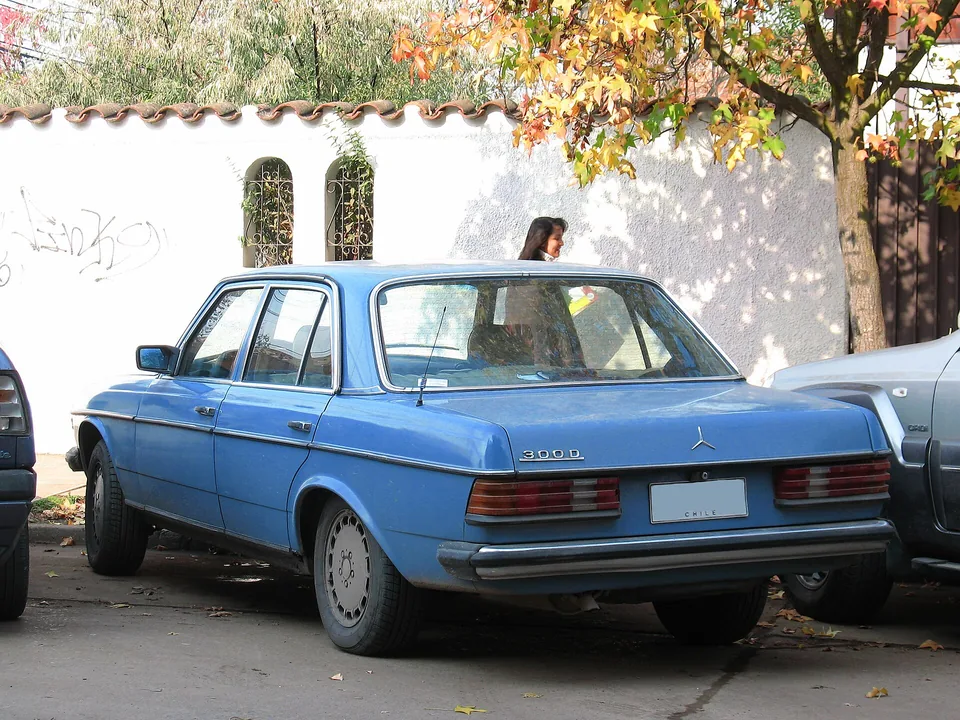
Mercedes-Benz 300D (W123)
Why 9.1: Three litres, five cylinders, 88 hp and a compression ratio you can hear in the starter motor. Mercedes engineered the W123 to a service life rather than a warranty period, and the taxi fleets proved the point: clearing 500,000 km on the original engine was ordinary rather than remarkable.
Layout
Natural habitat
Ride comfort
Sound
Five cylinders give the OM617 an off-beat, slightly lopsided idle that no four or six replicates, and the clatter is entirely honest. But it is a naturally aspirated diesel stopping at 4,500 rpm, and it never becomes anything you would call a note.
5-cylinder · naturally aspirated · 4,500 rpm redline · rated 3.6 / 10 for engine sound
Market value
Median asking price, good condition · €22k (1980) → €16k (2026), trending down · illustrative data
Child seats · ISOFIX
Built before ISOFIX existed, so there are no anchor points at all. A child seat here is a seatbelt installation, and the belt geometry of the period was not designed with one in mind.
Derived from production years and seating layout, not a per-car source. ISOFIX was standardised as ISO 13216 in 1997, required on new EU model types from 2011 and on all new EU cars from 2014.
The long version
Mercedes built 2,696,915 W123s between 1975 and 1986 and could not build them fast enough — German buyers queued for a year, and used cars changed hands above the list price of a new one, which is not a thing that happens to a slow diesel saloon unless the reputation is real. It was. The OM617 five-cylinder is the engine that defined what people mean by a durable diesel: enormous bearings, a cast-iron block, a mechanical injection pump with no electronics to fail, and an output so modest that nothing inside it is ever working hard. Rest-of-world 300Ds spent their first lives as German taxis and their second, third and fourth lives as taxis in West Africa, Turkey and South America, which is where a large share of the two and a half million went and where a good number still are. That is the ownership pattern in one sentence, and it is why this car sits at the top of the index rather than near it: nobody has ever bought a 300D as an appreciating asset, and the distances involved are absurd. The one qualification is the youngtimer market of the last decade, which has pulled clean, low-mileage, correctly-specified cars out of circulation and into collections at prices that would have been laughable in 2005. That is a thin layer on top of a very large fleet still doing the job it was built for, so it shaves the flip factor rather than the miles.