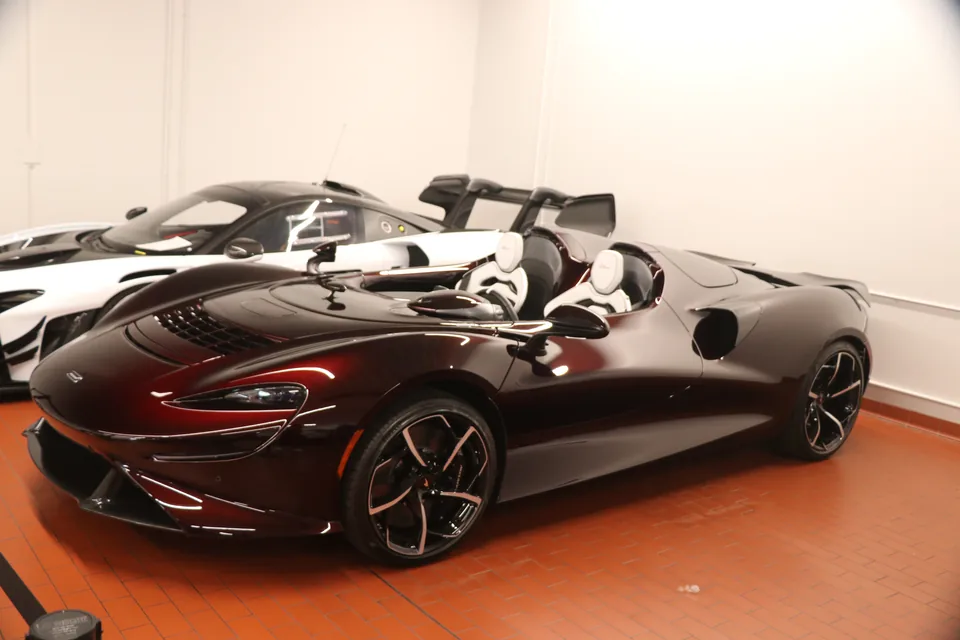
McLaren Elva
Why 3.8: McLaren planned 399, built toward 249, then cut the run again to 149 — a demand collapse for a roofless, windscreen-less speedster that even hypercar buyers found too impractical to want. The ones who did buy in got the Senna's engine and hydraulic steering with nothing at all between them and the air.
Layout
Natural habitat
Ride comfort
Sound
Roofless and, as launched, windscreen-free, so the top-exit exhaust and 8,500 rpm go straight into open air — about as unfiltered as a modern turbo car gets. But it is still the flat-voiced M840T, so exposure raises the volume rather than the quality.
8-cylinder · turbocharged · 8,500 rpm redline · rated 6.9 / 10 for engine sound
Market value
Median asking price, good condition · €1.6M (2020) → €1.7M (2026), trending up · illustrative data
Child seats · ISOFIX
There aren't any — strict two-seater.
No ISOFIX, consistent with every road-going McLaren.
Sold from launch with no windscreen, roof or side windows as standard (a windscreen became optional from 2021) — about as far from a family car as McLaren gets.
McLaren Elva press materials; general McLaren no-ISOFIX pattern (owner-community sourced, not manufacturer documentation)
The long version
The Elva is the most honest car in this batch about what a hypercar buyer actually wants, because McLaren found out the hard way: strip the roof, the windscreen, and a stack of weight off a Senna-derived chassis, and even at $1.69 million, demand cratered. McLaren cut the planned production run from 399 to 249 before most customer cars shipped, then cut it again to 149, and eventually added an optional windscreen just to make sales in the US legally and practically workable — close to the opposite of the car's original pitch. What's left is genuinely special when it's driven: the Senna's 804hp V8, its hydraulic steering, and a driving position with nothing between the driver and the weather. But 'nothing between the driver and the weather' also means most owners leave it parked whenever the forecast, or their schedule, doesn't cooperate — which is most days. Values have barely moved off the original sticker since 2020, unusually flat for a limited-run McLaren, more evidence that this was never the car people were fighting over.