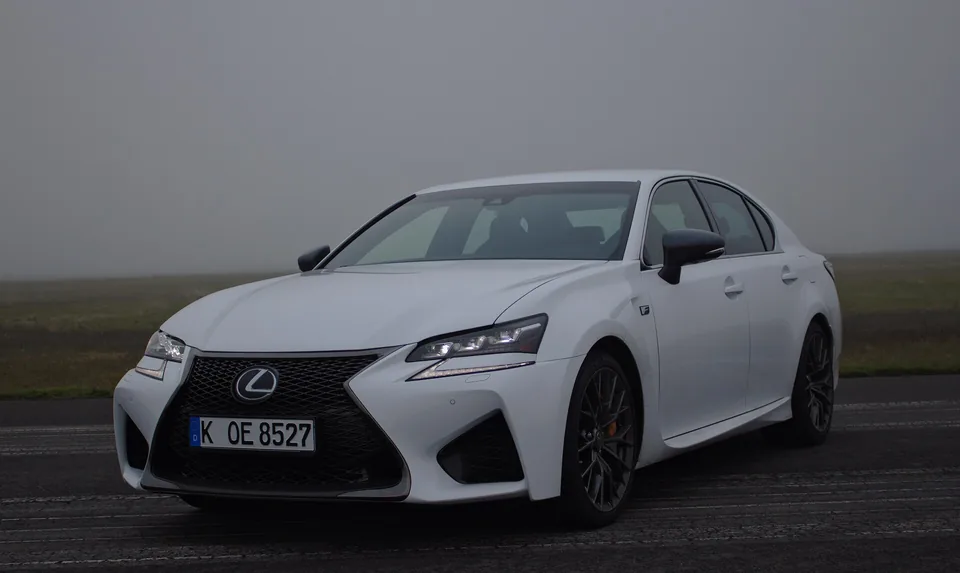
Lexus GS F
Why 7.4: The same naturally aspirated 5.0 as the RC F and IS 500, in the largest body Lexus put it in, sold in numbers small enough that most people have never seen one. It depreciated harder than either sibling, which is precisely why the survivors get used.
Layout
Natural habitat
Ride comfort
Sound
Lexus pipes intake pulses through a sound generator into the bulkhead, so the 2UR-GSE arrives as hard and metallic as it does in the RC F, and still runs to 7,300 rpm. But this is the biggest, most insulated body the engine ever went into, and the eight-speed short-shifts out of the good part. The F-car V8, one room further off.
8-cylinder · naturally aspirated · 7,300 rpm redline · rated 7.3 / 10 for engine sound
Market value
Median asking price, good condition · €77k (2016) → €42k (2026), trending down · illustrative data
Child seats · ISOFIX
Two ISOFIX positions on the outer rear seats, the outer pair being the ones the standard covers.
The rear anchors are the supported route — the manual points child seats there, and front-passenger ISOFIX is the exception rather than the rule. A belt-mounted seat up front needs the airbag off, and cars with a rear row don't always fit a deactivation switch, precisely because the rear seats exist.
Derived from production years and seating layout, not a per-car source. ISOFIX was standardised as ISO 13216 in 1997, required on new EU model types from 2011 and on all new EU cars from 2014.
The long version
Lexus launched the GS F in 2016 into a segment that had already left: every German rival in the class had gone turbocharged, and the GS itself was two years from cancellation. It shipped anyway, with the 2UR-GSE 5.0 V8 making 477 PS at 7,100 rpm, an eight-speed automatic, and the one piece of hardware no other F car received — a Torque Vectoring Differential with three selectable modes, which is the main reason a 1,865 kg saloon turns in as convincingly as it does. Very few were sold. Lexus moved a few hundred a year in most markets, the GS line ended in 2020, and the car spent its production run being overlooked in favour of the smaller RC F and, later, the IS 500. That obscurity is the whole ownership story. A GS F lost roughly 45 per cent of its list price within three years and has kept sliding, so the cars are now bought second-hand by people who specifically want a large naturally aspirated V8 saloon and have worked out that this is the cheapest one that also starts every morning for 200,000 miles. There is no collector premium, no speculative interest, and no reason to store one. They get used as daily cars, which is the highest-scoring behaviour this index recognises, and the reason the GS F rates above both of its better-known relatives.