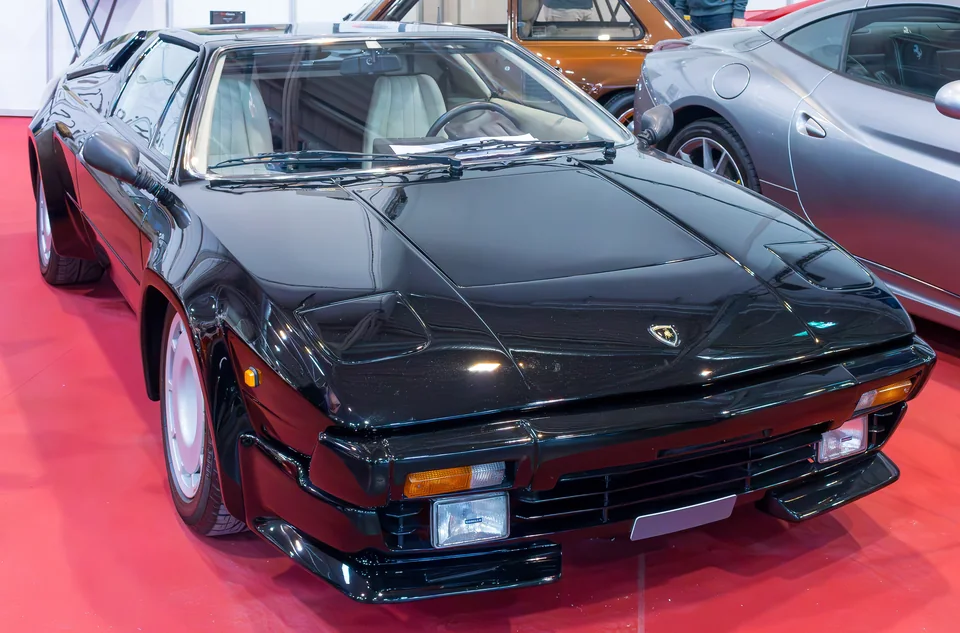
Lamborghini Jalpa
Why 5.3: A targa-roofed development of the Urraco line with the V8 taken out to 3.5 litres, built in the hundreds while the Countach took the attention and the money. Around 410 exist, which is few enough to make owners cautious and many enough that they are not museum pieces.
Layout
Natural habitat
Ride comfort
Sound
The 3.5 V8 is bored out from the Urraco's and sounds coarser and better for it, with carburettor induction right behind the bulkhead of a small targa. It is capped at 7,000 rpm and by a flat single-cam top end.
8-cylinder · naturally aspirated · 7,000 rpm redline · rated 7.6 / 10 for engine sound
Market value
Median asking price, good condition · €53k (1985) → €110k (2026), trending up · illustrative data
Child seats · ISOFIX
Built before ISOFIX existed, so there are no anchor points at all. A child seat here is a seatbelt installation in the only passenger seat there is.
Derived from production years and seating layout, not a per-car source. ISOFIX was standardised as ISO 13216 in 1997, required on new EU model types from 2011 and on all new EU cars from 2014.
The long version
By 1981 Lamborghini had been through receivership and the Urraco had become the Silhouette had become the Jalpa: same transverse V8 architecture, now 3,485 cc and 255 hp, with a lift-out roof panel that stows behind the seats and bodywork softened at the edges. It was the affordable Lamborghini for most of the decade, sold alongside a car with scissor doors and no rear visibility, and it lost that argument in every showroom it stood in. About 410 were built before Chrysler bought the company and cancelled it, leaving Lamborghini with no small car at all until the Gallardo appeared fifteen years later. That scarcity cuts both ways here: parts hunting and a small specialist network keep the annual mileage down, but nobody buys a Jalpa as a trade — the market is too thin and the badge too obscure for that to work — so they stay with the same enthusiasts for a very long time.