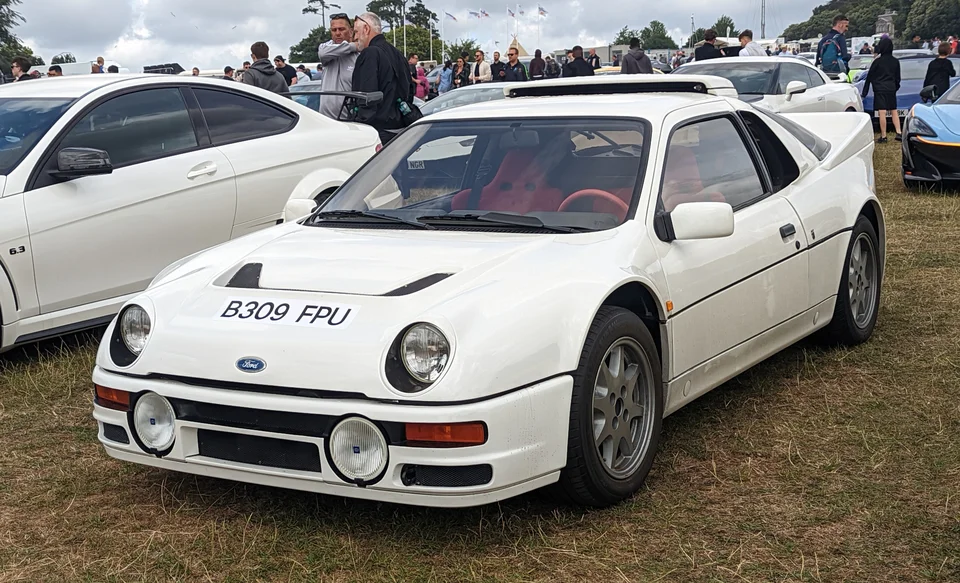
Ford RS200
Why 2.9: A carbon-and-Kevlar tub, a mid-mounted turbo four, and AWD — Ford's purpose-built Group B contender, with none of the touring-car or hatchback disguise its rivals wore. 200 built to homologate it; Group B was banned before the works car ever won a rally.
Layout
Natural habitat
Ride comfort
Sound
The BDT sits behind you and the transaxle ahead of you, so cam-gear whine, turbo chatter and transmission noise arrive from both directions in an uninsulated glassfibre shell. But it is a 1.8-litre four, and what you hear is mechanism rather than melody.
4-cylinder · turbocharged · 7,500 rpm redline · rated 6.4 / 10 for engine sound
Market value
Median asking price, good condition · €46k (1986) → €350k (2026), trending up · illustrative data
Child seats · ISOFIX
Built before ISOFIX existed, so there are no anchor points at all. A child seat here is a seatbelt installation in the only passenger seat there is.
Derived from production years and seating layout, not a per-car source. ISOFIX was standardised as ISO 13216 in 1997, required on new EU model types from 2011 and on all new EU cars from 2014.
The long version
Every other car in this batch started life as something else — a hatchback, a saloon, an existing coupe — reworked to satisfy homologation rules. The RS200 was the opposite: Ford designed it from a blank sheet purely to go rallying, with a Ghia-styled composite body over a spaceframe chassis and the turbo four and gearbox mounted just ahead of the rear axle, construction techniques closer to a Formula Ford than anything else on this list. It arrived late to Group B, in 1986 — the category's final full season, ended after a string of fatal accidents that killed drivers and spectators across multiple rallies that year, including one involving an RS200 in Portugal. The FIA banned the class outright before the season was over, and the works RS200 barely got the chance to prove itself on the stages it was built for. History has been kinder than 1986 was: the composite construction and genuine rally pedigree now read as exactly the engineering purity collectors want, and prices have climbed from used-supercar money to $300,000–400,000 for standard road cars, considerably more for the ultra-rare Evolution version. Notoriously poor rearward visibility and a turbo that does nothing below 4,000rpm keep it firmly in the trailer-queen column for most current owners.