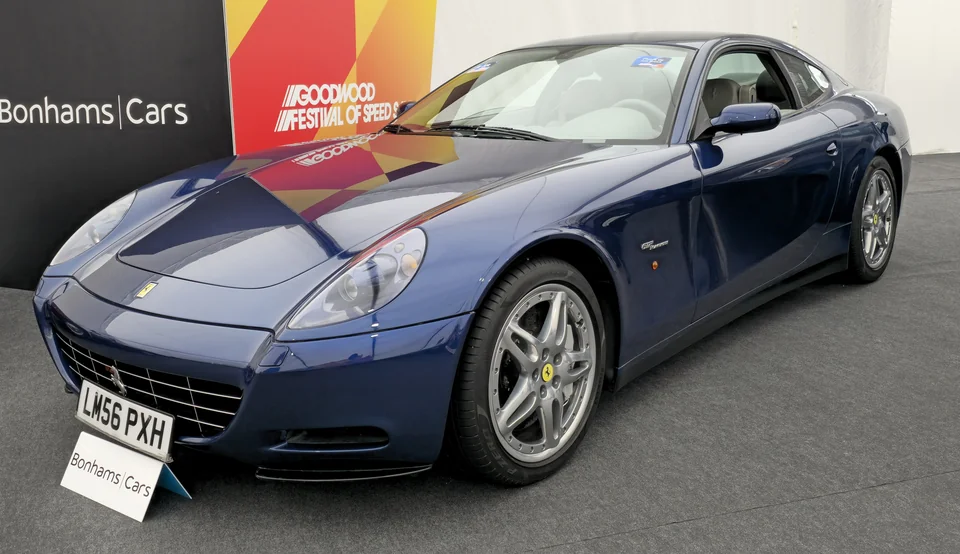
Ferrari 612 Scaglietti
Why 5.8: An all-aluminium spaceframe, a front-mid-mounted 5.7-litre V12 sitting entirely behind the front axle line, a rear transaxle, and four seats an adult can actually use. It replaced the 456 and preceded the FF, and it is the only one of the three that has spent any serious time being cheap.
Layout
Natural habitat
Ride comfort
Sound
A 5.7-litre V12 running to 7,600 rpm with nothing boosted in the way, and Ferrari never built a bad-sounding one. But the 612 is a grand tourer first and was insulated accordingly, so it sits below the mid-engined cars rather than beside them.
12-cylinder · naturally aspirated · 7,600 rpm redline · rated 8.8 / 10 for engine sound
Market value
Median asking price, good condition · €235k (2006) → €97k (2026), trending down · illustrative data
Child seats · ISOFIX
ISOFIX was spreading through these years rather than fitted across the board — whether a given car has rear anchors depends on its year and market.
Children were expected in the back. Front-passenger ISOFIX effectively didn't exist in this era, and airbag deactivation was patchy — treat the front seat as a no unless a specific car proves otherwise.
Derived from production years and seating layout, not a per-car source. ISOFIX was standardised as ISO 13216 in 1997, required on new EU model types from 2011 and on all new EU cars from 2014.
The long version
Ferrari built roughly 3,000 612s across seven years, which by the standards of the V12 GT line is a lot, and the styling — a deliberate reference to the one-off 375 MM built for Roberto Rossellini, with the long scalloped flanks — divided opinion from the day it was shown. That division is why the car spent a decade as the entry point to V12 Ferrari ownership: a $260,000 car in 2005 was a $75,000 car by 2017, at which point it was cheaper than a new 911 Turbo and came with twelve cylinders and four seats. Buyers at that price are a specific type. They are not collectors, because the 612 has never had a collector narrative; they are people who wanted a V12 Ferrari they could take on a long drive with a passenger and some luggage, which is precisely the job the car was designed for. What holds the mileage figure down is not reluctance but arithmetic — this is still a Ferrari with a cambelt-free but expensive service schedule, and annual costs discipline how far anyone takes it. Values have firmed since 2020, especially for the rare six-speed manual cars, of which fewer than 30 were built. The paddle-shift majority remains the most usable V12 Ferrari money can buy.