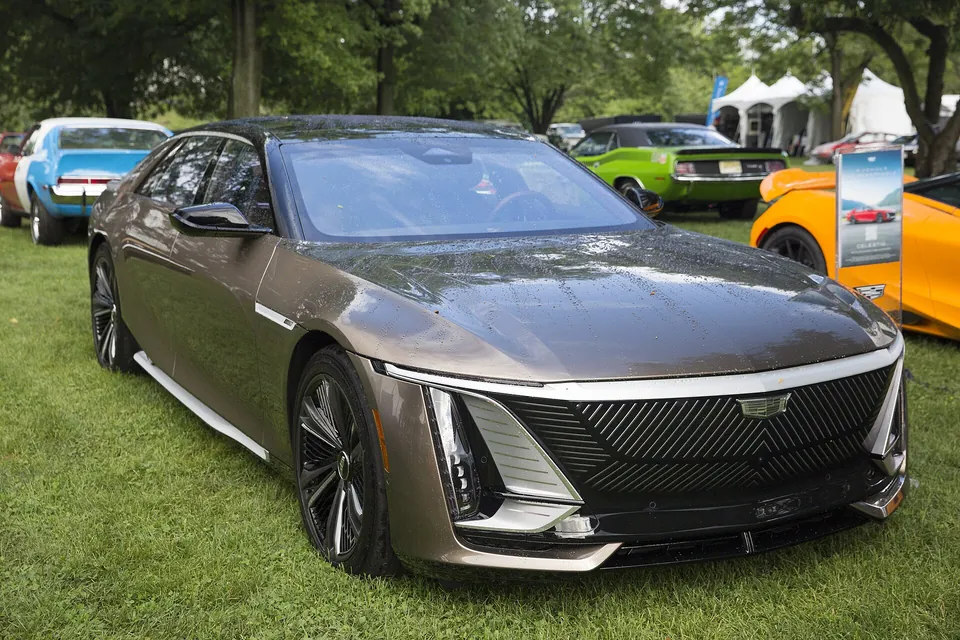
Cadillac Celestiq
Why 3.0: Hand-assembled at GM's Global Technical Center in Warren at a rate of roughly two cars a day, fewer than 500 a year, more than a hundred 3D-printed components, and no configurator — every buyer works through a bespoke commission with a Cadillac designer before the car is built.
Layout
Natural habitat
Ride comfort
Sound
There is a propulsion note played through exterior speakers for pedestrians, and 38 AKG speakers inside. But the cabin is engineered towards silence — active noise cancelling, 7.5 mm glass — so the driver hears almost none of it. Near the floor.
electric · rated 0.6 / 10 for engine sound
Market value
Median asking price, good condition · €313k (2024) → €276k (2026), trending down · illustrative data
Child seats · ISOFIX
Two ISOFIX positions on the outer rear seats, the outer pair being the ones the standard covers.
The rear anchors are the supported route — the manual points child seats there, and front-passenger ISOFIX is the exception rather than the rule. A belt-mounted seat up front needs the airbag off, and cars with a rear row don't always fit a deactivation switch, precisely because the rear seats exist.
Derived from production years and seating layout, not a per-car source. ISOFIX was standardised as ISO 13216 in 1997, required on new EU model types from 2011 and on all new EU cars from 2014.
The long version
The Celestiq is Cadillac attempting the 1957 Eldorado Brougham trick again: build something so expensive and so slowly that it re-establishes what the badge is allowed to mean. The numbers are real — 655 hp, 3.7 seconds to 60 mph, a 111 kWh Ultium pack, four separate heated, ventilated and massaging seats, air suspension with MagneRide, and 3,102 kg of it. So is the process: no trim levels, four inspiration themes, a designer assigned to each commission, and an assembly hall rather than a line. What it cannot escape is what a $340,000 hand-built car does after delivery, which is very little. Early cars are covering almost no distance, a few have already appeared for resale, and the track column is a rounding error. That is not a criticism of the engineering; it is a description of what this category of car is for. The interesting question is whether Cadillac keeps building it long enough for the second-hand ones to become somebody's actual transport.