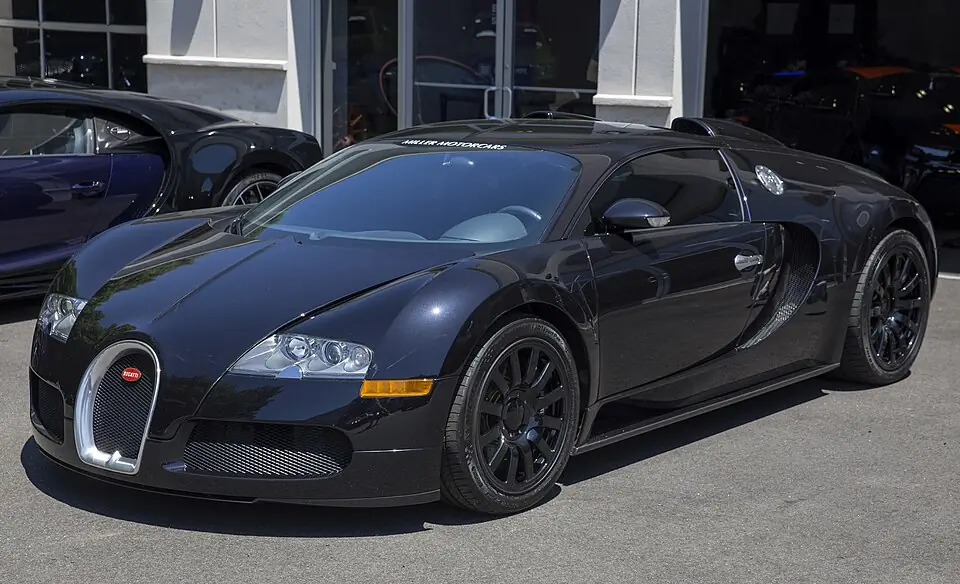
Bugatti Veyron
Why 2.5: A quad-turbo W16 and full-time AWD deliver the numbers with total isolation — period reviewers called the steering numb, and 1,888 kg of comfort-first engineering keeps the chassis and analog lenses well below what the DSG gearbox alone earns. Nothing here asks the driver for anything.
Layout
Natural habitat
Ride comfort
Sound
Sixteen cylinders and four turbos make a huge layered induction rush — ten radiators' worth of airflow and spool over a deep, muted roar. But Bugatti built it as a refined GT, so what reaches you is turbo and intake rather than engine. Volume without voice.
16-cylinder · turbocharged · 6,400 rpm redline · rated 6.0 / 10 for engine sound
Market value
Median asking price, good condition · €1.6M (2005) → €1.9M (2026), trending up · illustrative data
Child seats · ISOFIX
There aren't any — strict two-seater.
The only position there is — and the weak point of this era. Airbag cut-off switches only became routine in the mid-2000s; many of these cars have none from the factory, which rules out a rear-facing seat entirely unless a dealer-fitted deactivation was installed. Forward-facing on the belt, seat slid fully back, is what the period manuals allow.
Derived from production years and seating layout, not a per-car source. ISOFIX was standardised as ISO 13216 in 1997, required on new EU model types from 2011 and on all new EU cars from 2014.
The long version
Bugatti built the Veyron to answer one question — how fast can a road car go — and every decision followed from that brief, including the insulation from the process that made the speed possible. Values sagged through the depreciation years as early buyers moved on, then climbed once the badge cemented itself as the car that restarted the horsepower war. What survived is mostly long-term holders rather than flippers: buyers who bought the headline, insured it properly, and let the mileage accumulate slowly in a climate-controlled bay.