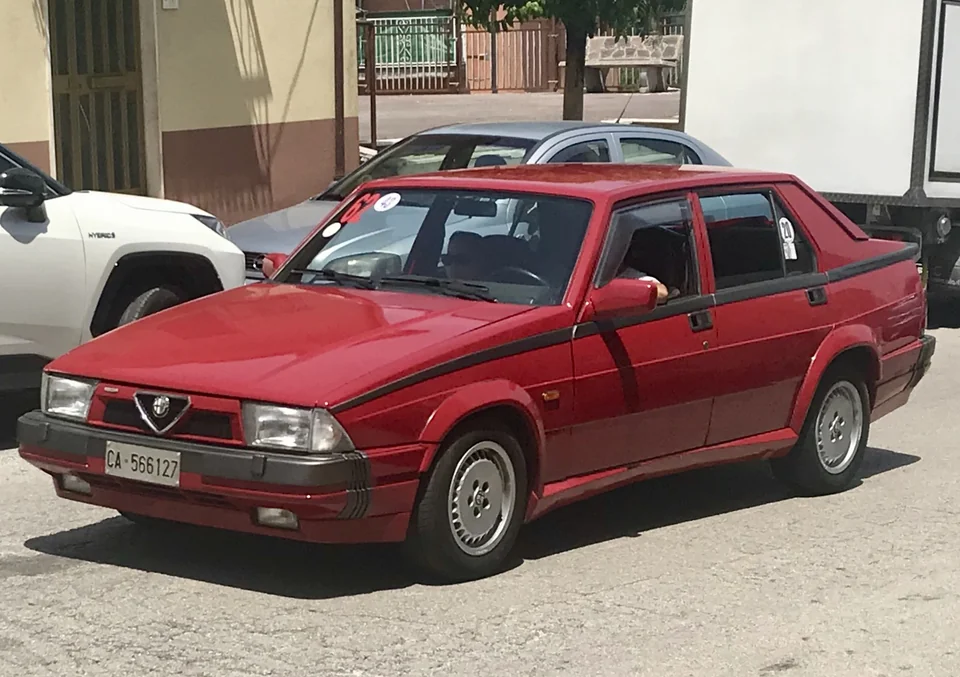
Alfa Romeo 75 Turbo
Why 6.8: The last car Alfa engineered as an independent company, and mechanically the most interesting saloon of its decade: gearbox and clutch at the rear axle, De Dion tube, inboard rear brakes, weight distribution close to even. The 1.8 turbo made 155 PS and later 165, and never came near a US showroom.
Layout
Natural habitat
Ride comfort
Sound
The Alfa twin-cam keeps a hard edge even boosted, and the rear transaxle adds a whine you hear in no other saloon of the period. But the turbo smothers the top end at 5,800 rpm, so the drivetrain supplies as much of the noise as the engine does.
4-cylinder · turbocharged · 5,800 rpm redline · rated 5.8 / 10 for engine sound
Market value
Median asking price, good condition · €17k (1987) → €24k (2026), trending up · illustrative data
Child seats · ISOFIX
Built before ISOFIX existed, so there are no anchor points at all. A child seat here is a seatbelt installation, and the belt geometry of the period was not designed with one in mind.
Derived from production years and seating layout, not a per-car source. ISOFIX was standardised as ISO 13216 in 1997, required on new EU model types from 2011 and on all new EU cars from 2014.
The long version
The 75 was the last car Alfa Romeo engineered before Fiat took over, and it kept the Alfetta's transaxle layout right to the end: a five-speed gearbox and the clutch mounted back at the rear axle, a De Dion tube locating the rear wheels, inboard rear brakes, and a front-to-rear balance close to even in a car whose styling suggests nothing of the kind. The 1.8-litre turbo arrived in 1986 with 155 PS and 226 Nm, and the Quadrifoglio Verde revision in 1990 lifted it to 165 — modest numbers for a car this involving, because the chassis is the point and the engine is the excuse. North America got the 75 badged as the Milano, but only with the 2.5 and 3.0 V6 engines and only from 1987 to 1989; the four-cylinder turbo was never sold there, which puts it in the same bracket as the BMW 2002 Turbo — a variant that never crossed even though the body did. A European trim called the Turbo America adds to the confusion by wearing the US-market impact bumpers while never having been available in America. Values sat near nothing for two decades and have roughly quadrupled since, but these are still cheap enough that owners drive them, and anyone who buys one on looks alone gets a surprise the first time they turn in.