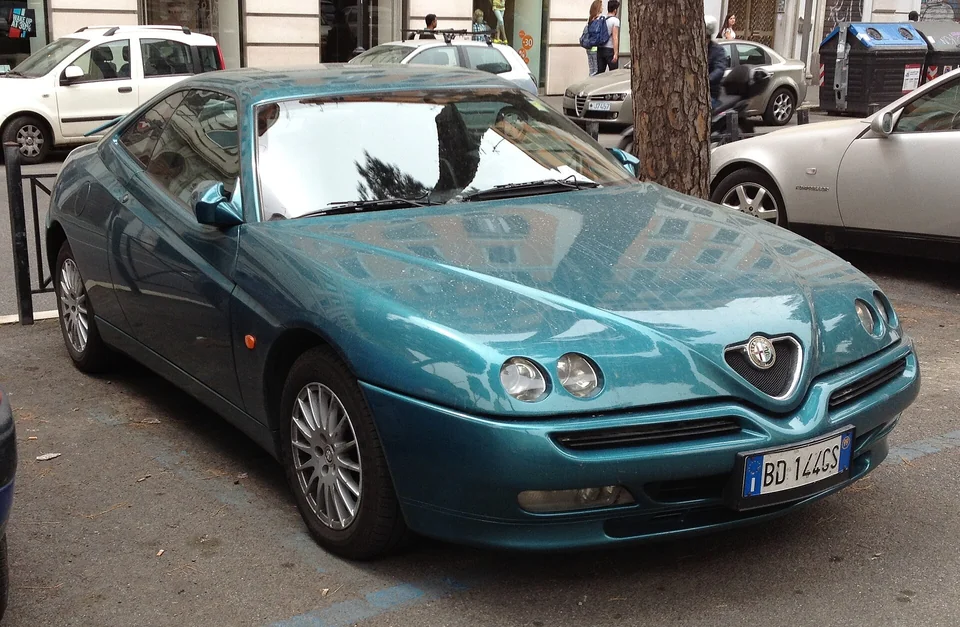
Alfa Romeo GTV (916)
Why 7.2: Enrico Fumia's shape for Pininfarina is why most people buy one, and it has aged better than nearly anything else drawn in the same years. Underneath is a front-drive Fiat platform with a 2.0 Twin Spark or, at the top, the 3.2 Busso V6 — a car that spent fifteen years worth less than its own cam-belt service.
Layout
Natural habitat
Ride comfort
Sound
The 24-valve Busso keeps its induction wail intact under the Pininfarina bonnet, and it is the reason nobody recommends the four-cylinder version. Nineties emissions plumbing and 6,200 rpm cap it, leaving it a shade below the older, rawer Alfa sixes.
6-cylinder · naturally aspirated · 6,200 rpm redline · rated 8.1 / 10 for engine sound
Market value
Median asking price, good condition · €30k (1996) → €14k (2026), trending down · illustrative data
Child seats · ISOFIX
ISOFIX was spreading through these years rather than fitted across the board — whether a given car has rear anchors depends on its year and market.
Children were expected in the back. Front-passenger ISOFIX effectively didn't exist in this era, and airbag deactivation was patchy — treat the front seat as a no unless a specific car proves otherwise.
Derived from production years and seating layout, not a per-car source. ISOFIX was standardised as ISO 13216 in 1997, required on new EU model types from 2011 and on all new EU cars from 2014.
The long version
The 916 GTV was designed by Enrico Fumia at Pininfarina in the late 1980s and reached production close to intact, which is why the proportions still read as deliberate thirty years on — the rising waistline, the cut-off tail, the way the front wings fall away from the shield. Underneath it is a good deal more ordinary: a front-wheel-drive platform shared with the Fiat Tipo family, carrying engines from a 150 PS 2.0 Twin Spark up to a 240 PS 3.2-litre Busso V6 in the final cars, with a 200 PS 2.0 V6 Turbo sold in Italy in between. The V6 cars understeer if you insist, and sound magnificent while doing it; the Twin Sparks are the ones people actually own and run. Alfa Romeo had withdrawn from the United States before the 916 existed, so it was never sold there in any form. Values fell to almost nothing through the 2010s — the phase in which a lot of these were scrapped over suspension bushes and belt intervals — and the market only began correcting once the shape was widely accepted as a design landmark rather than just an old Alfa. That collapse is exactly why the ownership profile is so healthy: nobody bought a GTV as an investment, so what survives is being driven.