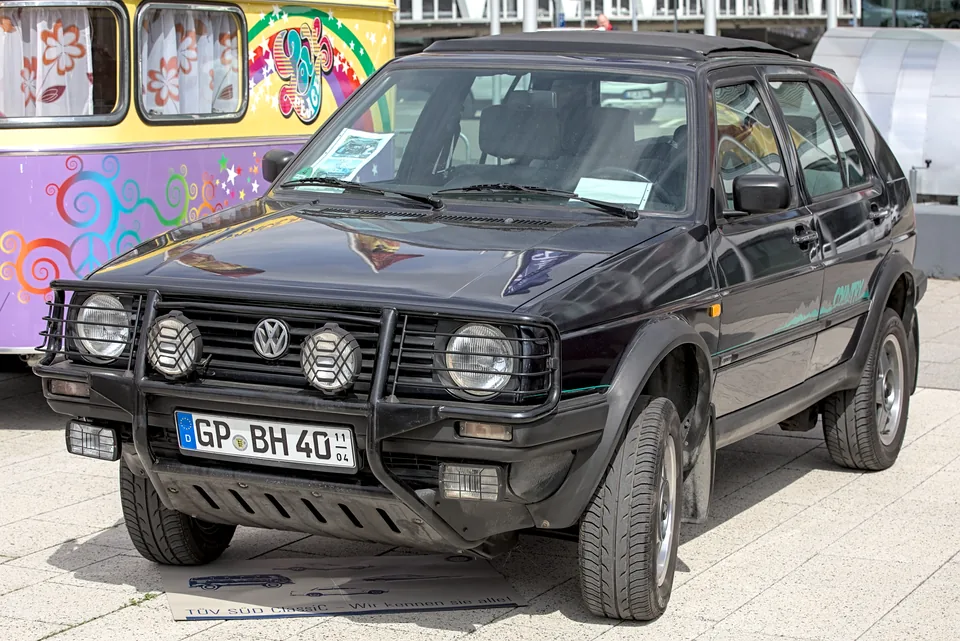
Volkswagen Golf Country
Why 5.0: Volkswagen took a Mk2 Golf syncro, sent it to Steyr-Daimler-Puch in Graz, and had 438 parts added to it: a raised subframe giving 210 mm of ground clearance, a tubular bull bar at each end, an engine skid plate, and a spare wheel on a swing-away frame at the back. 7,735 were built before somebody worked out how much each one was costing.
Layout
Natural habitat
Ride comfort
Sound
There is no carpet worth the name and a bull bar resonating in front of the grille, so you hear the eight-valve 1.8 and the syncro propshaft working. But the RP is the most ordinary engine Volkswagen made in the eighties — 98 PS, two valves a cylinder, a family-hatchback silencer. Mechanical noise, not a note.
4-cylinder · naturally aspirated · 6,000 rpm redline · rated 3.9 / 10 for engine sound
Market value
Median asking price, good condition · €23k (1990) → €35k (2026), trending up · illustrative data
Child seats · ISOFIX
Built before ISOFIX existed, so there are no anchor points at all. A child seat here is a seatbelt installation, and the belt geometry of the period was not designed with one in mind.
Derived from production years and seating layout, not a per-car source. ISOFIX was standardised as ISO 13216 in 1997, required on new EU model types from 2011 and on all new EU cars from 2014.
The long version
The Golf Country is the most literal answer anybody has ever given to the question of what a small four-wheel-drive car should be. Rather than design a platform, Volkswagen shipped finished Golf syncros to Steyr in Austria, where the body was lifted on a new tubular subframe, given proper underbody protection, and fitted with the visual apparatus of a serious off-roader — the bars, the driving lamps, the external spare. Underneath it is an ordinary 98 PS 1.8-litre eight-valve Golf with a viscous-coupling four-wheel-drive system, which means it is slow, and that has never mattered to anybody who owns one. Production ran for barely eighteen months and stopped at 7,735 cars, plus 558 chrome-package examples and fifty 112 PS Country GTIs built for Volkswagen staff and never sold to the public. For twenty years afterwards this was a cheap curiosity kept alive in the Alps, where the ground clearance and the syncro system actually earned their keep on farm tracks and ski-resort approach roads in February. That ended sometime around 2015. The Country is now a collectable, prices have gone from four figures to well past €30,000 for a good one, and a meaningful share of survivors have moved from Tyrolean garages into collections — which is what holds its Index score down rather than anything the car does. It remains the only Golf you can look at and immediately understand.