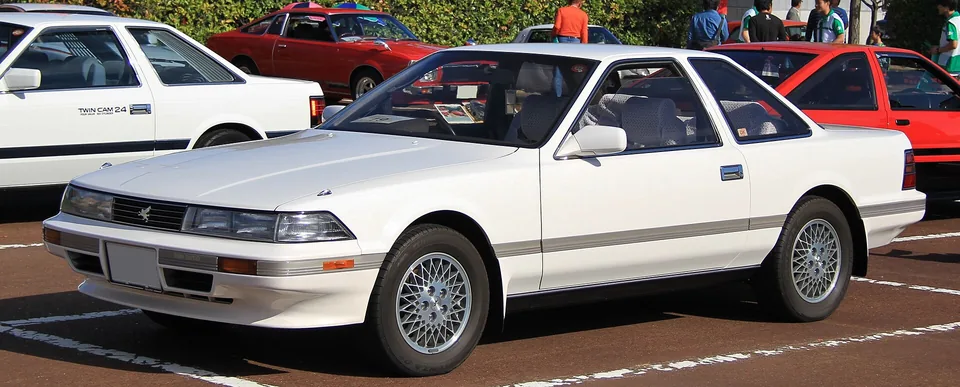
Toyota Soarer (Z20)
Why 7.2: The Z20 was never exported — the Lexus SC that Western buyers know arrived on the generation after it — so this is the bubble-era Toyota flagship as Japan actually got it, CRT touchscreen and all. The 2.0GT Twin Turbo exists because Japan taxed engines by displacement: rather than sell a cheaper car with a bigger engine, Toyota put two small turbochargers on a two-litre twin-cam six.
Layout
Natural habitat
Ride comfort
Sound
Two small turbochargers on a 24-valve two-litre six give a busy, layered spool that one large turbo cannot, and the 1G-GTE stays smooth to 7,000 rpm. But two litres split six ways is a thin noise, and this is a luxury coupé built to isolate you from exactly this. Interesting on paper, distant in the cabin.
6-cylinder · turbocharged · 7,000 rpm redline · rated 5.2 / 10 for engine sound
Market value
Median asking price, good condition · €25k (1988) → €16k (2026), trending down · illustrative data
Child seats · ISOFIX
Built before ISOFIX existed, so there are no anchor points at all. A child seat here is a seatbelt installation, and the belt geometry of the period was not designed with one in mind.
Derived from production years and seating layout, not a per-car source. ISOFIX was standardised as ISO 13216 in 1997, required on new EU model types from 2011 and on all new EU cars from 2014.
The long version
The Soarer is the clearest surviving artefact of the moment when Japanese carmakers had more money than restraint. The Z20 arrived in January 1986 with an options list that reads like a concept car’s: electronically modulated damping, an air suspension setup on the senior grades, a digital instrument cluster, and Electro Multi Vision — a CRT screen below the climate controls, operated by touch, showing navigation loaded from a cassette. It was Japan-only in every model year, which is why almost nobody outside the country encountered one until the twenty-five-year import windows began opening. The engine range is the other half of the story. Japan’s annual road tax stepped up sharply with displacement, so a two-litre car was materially cheaper to keep than a three-litre one, and Toyota’s answer was the 1G-GTE: a 24-valve two-litre six with two small turbochargers, 185 PS, and a response curve one large turbo could not have delivered. Above it sat the 7M-GTE three-litre for buyers who did not care about the tax. What has happened since is predictable enough. Most Z20s spent two decades as cheap fast coupés — modified, drifted, scrapped — and the clean survivors are now being collected in Japan at prices that would have looked absurd in 2005. Standard, unmodified 2.0GT Twin Turbos are the scarce thing.