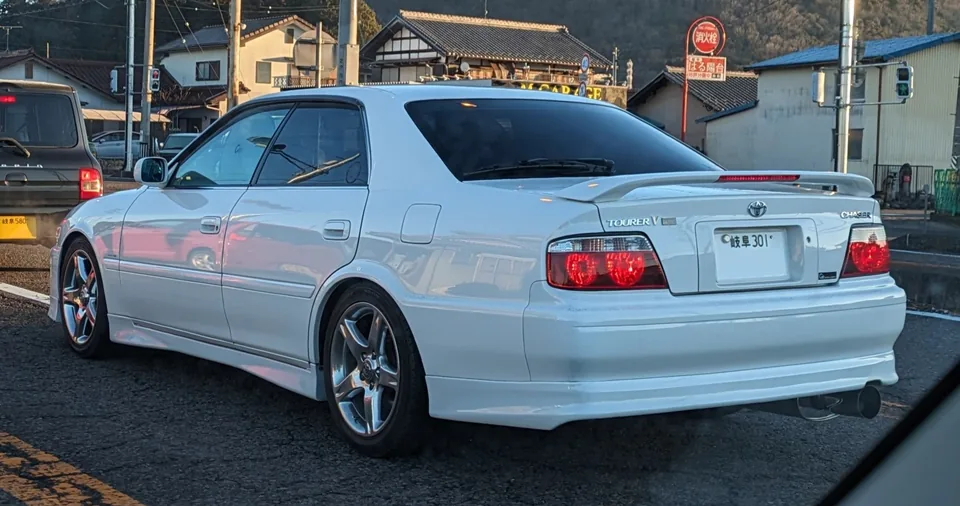
Toyota Chaser Tourer V (JZX100)
Why 7.7: The Tourer V is the top JZX100 Chaser: a single-turbo 1JZ-GTE at the 280 PS ceiling every Japanese maker agreed to, a five-speed manual, a limited-slip differential and firmer suspension, in a body that reads as an ordinary mid-size Toyota to anyone not looking. It was sold only in Japan, which is most of why it costs what it costs now.
Layout
Natural habitat
Ride comfort
Sound
The 1JZ-GTE is a smooth single-turbo straight-six with a clean, even six-cylinder hum under load. But Toyota built this as a rep's saloon: heavy silencing, 7,000 rpm, and the interesting noises only appear after someone fits another exhaust.
6-cylinder · turbocharged · 7,000 rpm redline · rated 6.2 / 10 for engine sound
Market value
Median asking price, good condition · €26k (1998) → €40k (2026), trending up · illustrative data
Child seats · ISOFIX
ISOFIX was spreading through these years rather than fitted across the board — whether a given car has rear anchors depends on its year and market.
Children were expected in the back. Front-passenger ISOFIX effectively didn't exist in this era, and airbag deactivation was patchy — treat the front seat as a no unless a specific car proves otherwise.
Derived from production years and seating layout, not a per-car source. ISOFIX was standardised as ISO 13216 in 1997, required on new EU model types from 2011 and on all new EU cars from 2014.
The long version
Toyota built three near-identical saloons on the X100 platform — Mark II, Chaser and Cresta — and specified the Chaser Tourer V for people who wanted to drive: the 1JZ-GTE turbocharged straight-six, a manual gearbox, a viscous limited-slip differential and a chassis that takes far more power than the 280 PS it left the factory claiming. None were exported, so every car outside Japan is a private import, and American buyers only started clearing them through the 25-year rule in 2021. The value chart shows exactly that: a long flat trough through the 2000s when a Chaser was just a used Toyota in Japan, then a steep climb once export demand found them. Ownership splits in two. A very large share have been drifted, boosted and rebuilt, because the 1JZ takes it cheerfully and the cars were cheap for twenty years; the ones that were not are held by people who wanted this specific combination and use them as everyday saloons, which they are still genuinely good at. Parts are plentiful because Toyota made enormous numbers of the platform, and that keeps the survivors on the road rather than in storage.