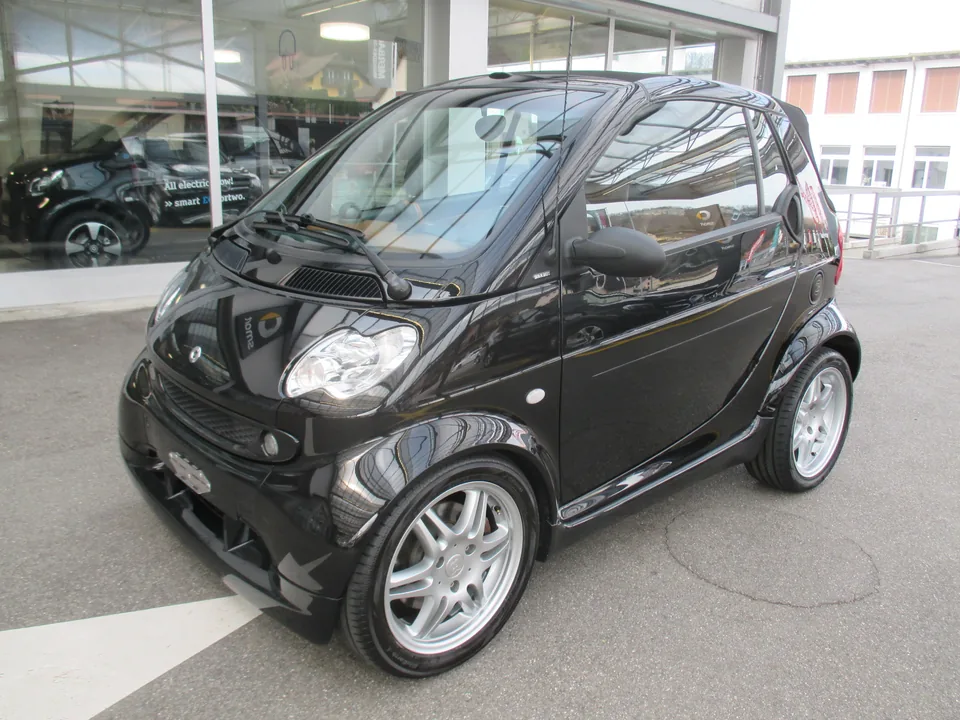
Smart Fortwo Brabus (450)
Why 7.0: Brabus normally bolts superchargers onto V12 Mercedes limousines. Here it took a 698 cc three-cylinder turbo to 75 PS, fitted staggered Monoblock wheels, lowered it, and produced a 2.5-metre car with a rear engine, rear-wheel drive and a genuinely silly footprint-to-tyre ratio.
Layout
Natural habitat
Ride comfort
Sound
The 698cc triple sits under the boot floor about 40 cm behind your head with a Brabus exhaust on it, so the offbeat three-cylinder thrum and the turbo whistle arrive with nothing in between. But there is no room for a silencer of consequence, and the automated clutch cuts it dead between every ratio. Comic, and brief.
3-cylinder · turbocharged · 5,800 rpm redline · rated 5.3 / 10 for engine sound
Market value
Median asking price, good condition · €20k (2004) → €7k (2026), trending down · illustrative data
Child seats · ISOFIX
There aren't any — strict two-seater.
The only position there is — and the weak point of this era. Airbag cut-off switches only became routine in the mid-2000s; many of these cars have none from the factory, which rules out a rear-facing seat entirely unless a dealer-fitted deactivation was installed. Forward-facing on the belt, seat slid fully back, is what the period manuals allow.
Derived from production years and seating layout, not a per-car source. ISOFIX was standardised as ISO 13216 in 1997, required on new EU model types from 2011 and on all new EU cars from 2014.
The long version
The 450 is the original Smart, the one designed around a coloured plastic body hung on a visible steel Tridion safety cell, with a three-cylinder engine mounted under the boot floor driving the rear wheels. It was a serious piece of packaging and a commercial disappointment, and the Brabus version is what happened when Mercedes handed the problem to its in-house tuner: 75 PS instead of 61, a reworked exhaust, uprated brakes, a 20 mm drop and Monoblock VI wheels in staggered widths, sold through Smart dealers with a warranty. The performance numbers are not the point — nothing with 74 hp is quick — but the thing steers with the immediacy of a go-kart, the engine is behind you, and the whole car is shorter than most hatchbacks are wide. The automated single-clutch gearbox remains its great flaw; it pauses between every ratio and no amount of Brabus badging fixes it. What keeps the Index score up is how these have been used. A Smart is a city car, so it never covers vast distances, but it covers them constantly and cheaply, and the Brabus versions have stayed in the hands of people who bought them because they wanted this specific ridiculous thing. The first-generation car never reached the United States — America got the 451 from January 2008 — so the original, the interesting one, is import-only there. Values have firmed slightly. Nobody is speculating.