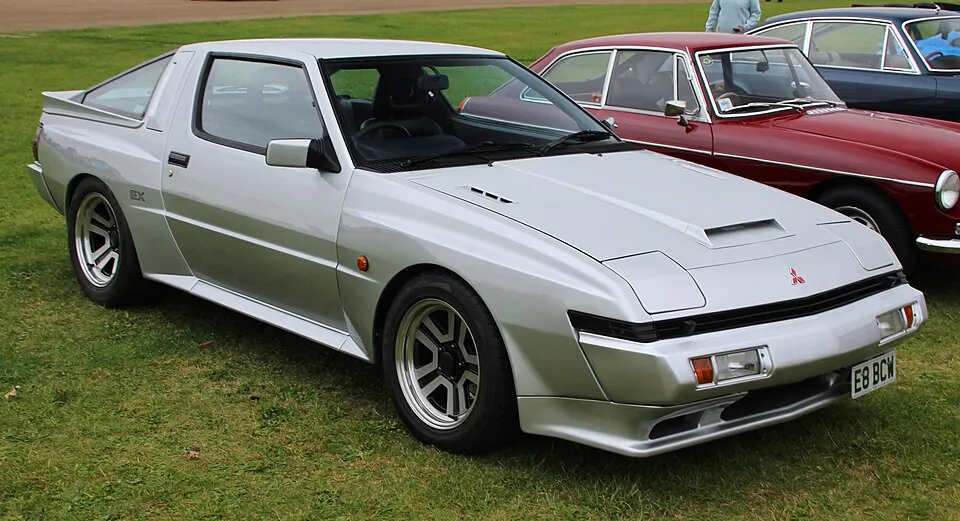
Mitsubishi Starion
Why 6.6: Mitsubishi's turbocharged rear-drive coupe of the eighties, sold in America under four different badges at once — its own, plus Chrysler, Dodge and Plymouth Conquest. The wide-body cars are the ones people want, and the balance-shaft design that keeps its big four smooth was licensed by Porsche for the 944.
Layout
Natural habitat
Ride comfort
Sound
The 2.6 is among the largest fours ever fitted to a road car and boosts with a heavy low whoosh. The irony is the balance shafts: they cancel exactly the big-four thrum that would give it character, leaving a smooth, boomy engine with little to say.
4-cylinder · turbocharged · 6,000 rpm redline · rated 4.9 / 10 for engine sound
Market value
Median asking price, good condition · €17k (1988) → €20k (2026), trending up · illustrative data
Child seats · ISOFIX
Built before ISOFIX existed, so there are no anchor points at all. A child seat here is a seatbelt installation, and the belt geometry of the period was not designed with one in mind.
Derived from production years and seating layout, not a per-car source. ISOFIX was standardised as ISO 13216 in 1997, required on new EU model types from 2011 and on all new EU cars from 2014.
The long version
The Starion arrived in 1982 as Mitsubishi's answer to the Supra and the 280ZX: front engine, rear drive, pop-up headlamps, and a turbocharged four rather than a six. Displacement depended on the market — a 2.0 for Japan and much of Europe, a 2.6 for America and the later wide-body cars — and the flared-arch versions from 1986 onward, badged ESI-R in the States and EX in Britain, are the ones that have aged into desirability. What is genuinely unusual is under the cam cover: Mitsubishi's Silent Shaft balance-shaft system, an arrangement good enough that Porsche licensed the patent for the 944's large four-cylinder and Saab did the same. In America it was sold simultaneously as a Mitsubishi and, through the Chrysler partnership, as the Conquest under three different badges, which has left a confusing survivor population and a parts supply split across four brands. Rust and thirty years of cheap ownership did the rest. Prices have started to move as eighties Japanese coupes get taken seriously, but from far enough down that these are still bought to be driven.