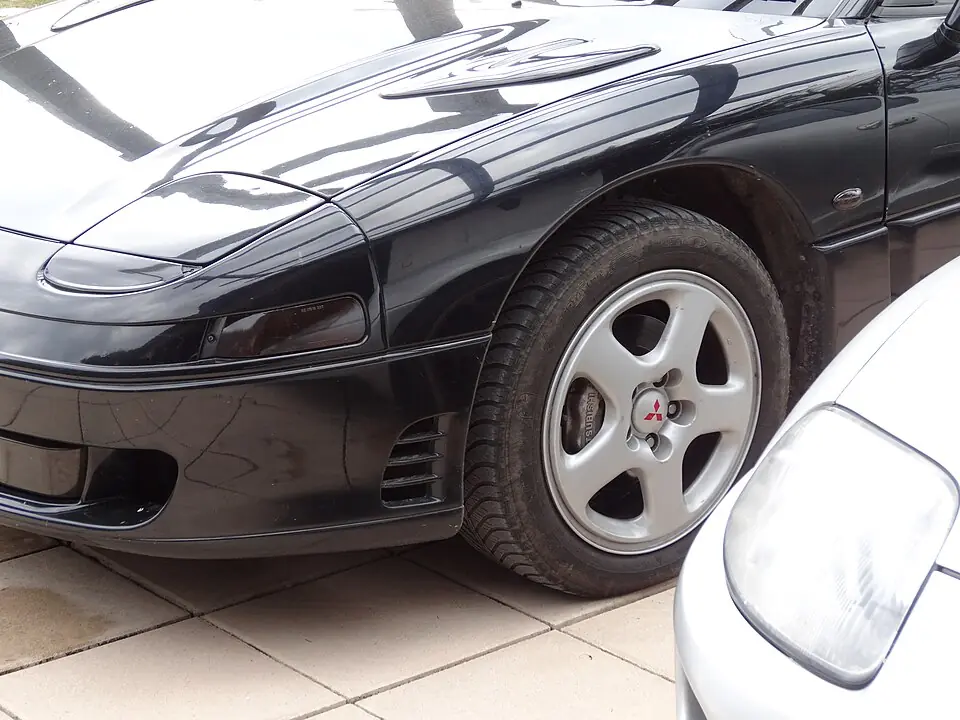
Mitsubishi 3000GT VR-4
Why 5.0: Twin turbos, AWD, four-wheel steering, active aero — 90s Mitsubishi showing off everything at once. Heavy then, collectible now; the survivors mostly cruise.
Layout
Natural habitat
Ride comfort
Sound
The 6G72 twin-turbo gives a soft V6 murmur and some genuine whistle once both blowers are on song. But this is a heavy technology flagship built for isolation, and the exhaust was tuned to be inoffensive. Respect earned for the engineering, none of it for the noise.
6-cylinder · turbocharged · 7,000 rpm redline · rated 4.5 / 10 for engine sound
Market value
Median asking price, good condition · €14k (2000) → €37k (2026), trending up · illustrative data
Child seats · ISOFIX
ISOFIX was spreading through these years rather than fitted across the board — whether a given car has rear anchors depends on its year and market.
Children were expected in the back. Front-passenger ISOFIX effectively didn't exist in this era, and airbag deactivation was patchy — treat the front seat as a no unless a specific car proves otherwise.
Derived from production years and seating layout, not a per-car source. ISOFIX was standardised as ISO 13216 in 1997, required on new EU model types from 2011 and on all new EU cars from 2014.
The long version
This was never really a corner-carver even when new — nearly 3,800 lbs of active aero, four-wheel steering, and twin turbos meant it excelled at cruising with a spec sheet nobody else could match, not at being thrown around. That original character explains why survivors mostly still cruise rather than track: the ownership behavior didn't have to change much to become 'collector appropriate.' The current owner base skews toward people fascinated by the sheer everything-at-once engineering ambition of the era, treating the car as a rolling museum piece for peak-90s Mitsubishi rather than a driver's tool that got sidelined.