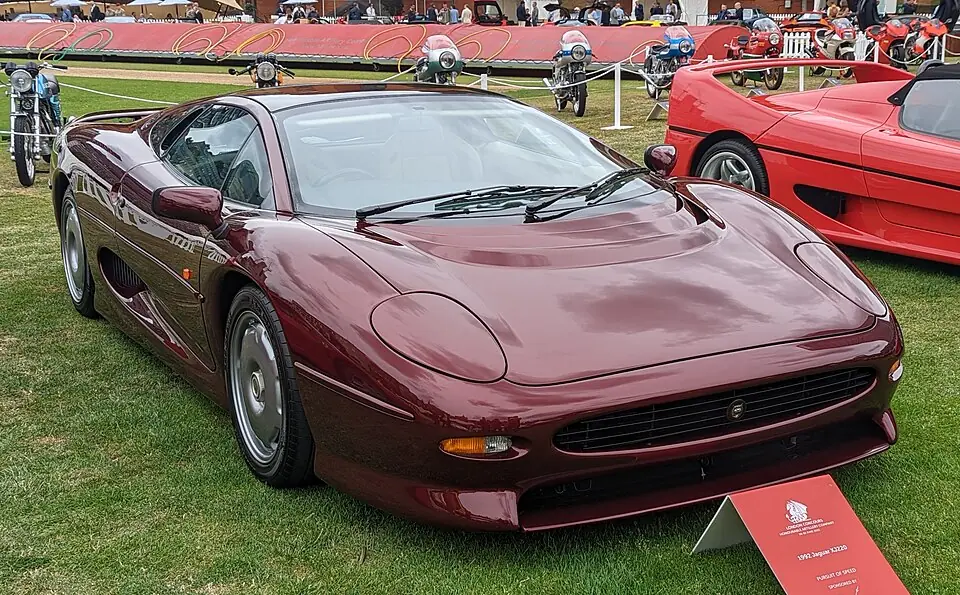
Jaguar XJ220
Why 5.5: Unassisted steering, no ABS, no traction control and a genuine 5-speed manual make this the most analog car in the entire batch — only the twin-turbo V6, less exotic than the concept's promised V12, keeps any lens shy of the very top. A 1990s recession crushed values early enough that a real driving culture had decades to take hold.
Layout
Natural habitat
Ride comfort
Sound
The Le Mans-derived turbo V6 makes a low guttural roar with real racing hardness to it, and there is no insulation to soften it. But it clatters at idle and never turns sonorous, and buyers promised a V12 have said so since 1992.
6-cylinder · turbocharged · 7,900 rpm redline · rated 6.3 / 10 for engine sound
Market value
Median asking price, good condition · €651k (1992) → €828k (2026), trending up · illustrative data
Child seats · ISOFIX
Built before ISOFIX existed, so there are no anchor points at all. A child seat here is a seatbelt installation in the only passenger seat there is.
Derived from production years and seating layout, not a per-car source. ISOFIX was standardised as ISO 13216 in 1997, required on new EU model types from 2011 and on all new EU cars from 2014.
The long version
Jaguar's decision to swap the concept car's V12 and all-wheel drive for a twin-turbo V6 and rear-wheel drive infuriated early depositors, but it also produced one of the last hypercars built with zero electronic safety net — no ABS, no traction control, unassisted steering on a car nearly as wide as a small truck. Values crashed through the 1990s recession and stayed low for a decade, long enough that surviving cars became genuine drivers rather than investments before the market rediscovered them. Many are still serviced through Jaguar's own heritage channel today, evidence of owners who kept using them.