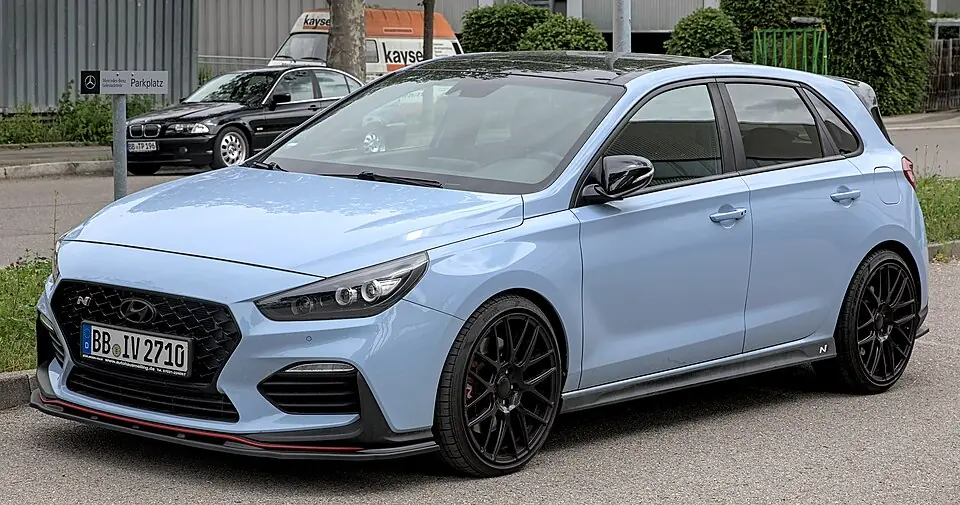
Hyundai i30 N
Why 8.5: Albert Biermann's proof that N wasn't a marketing exercise. Bought with own money by people who cross-shopped GTIs, driven daily, and utterly unloved by speculators — the healthiest ownership profile money can buy.
Layout
Natural habitat
Ride comfort
Sound
The variable exhaust pops and cracks on every lift, which is the trick most owners buy the car for. But the 2.0 turbo four beneath it is ordinary, the drama is valve and speaker rather than engine, and 6,750 rpm ends it early. Clearly manufactured.
4-cylinder · turbocharged · 6,750 rpm redline · rated 5.5 / 10 for engine sound
Market value
Median asking price, good condition · €29k (2019) → €21k (2026), trending down · illustrative data
Child seats · ISOFIX
"ISOFIX anchorages have been provided in the left and right outboard rear seating positions" — rear centre is explicitly excluded ("There are no ISOFIX anchorages provided for this seat").
Owner's manual confines ISOFIX to the rear; no front-seat ISOFIX position is documented (a web search summary claimed otherwise but did not survive checking the primary manual text).
Hyundai i30 Owner's Manual (quoted verbatim via hi30.net manual mirror)
The long version
Depreciation here is not a warning sign, it is practically a feature — nobody buying an i30 N is pricing in resale, and the steady value decline just confirms the car is doing what it was bought to do: commute all week, get thrashed on a track day, repeat, with no residual-value anxiety weighing on any of it. It has not built the cult mystique of the older hot hatches on this list, partly because it is still too new and partly because Hyundai never built a legend around it, just a genuinely sorted chassis. That absence of mythology is itself the tell.