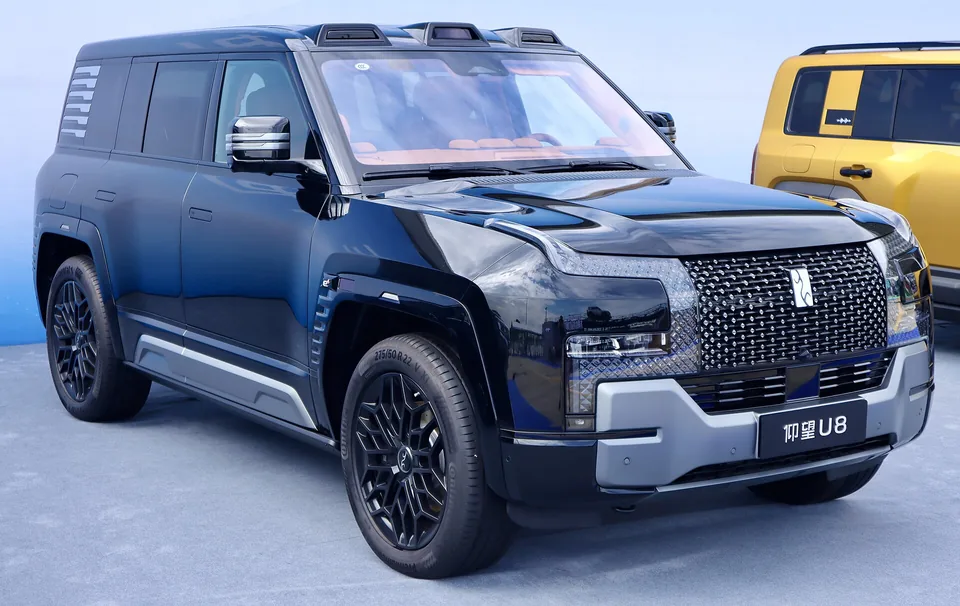
BYD Yangwang U8
Why 4.3: One 220 kW motor per wheel with no mechanical link between them, so it can rotate on the spot, drive on three wheels with a puncture, and float long enough to reach a bank. The 2.0-litre petrol engine is a generator — it never touches the wheels.
Layout
Natural habitat
Ride comfort
Sound
The petrol generator does make a noise, which is more than most electric SUVs manage. But it runs to its own schedule rather than your right foot, so what you hear has no relation to what the car is doing. Four motors and a droning box is not an engine note.
electric · rated 0.8 / 10 for engine sound
Market value
Median asking price, good condition · €140k (2023) → €97k (2026), trending down · illustrative data
Child seats · ISOFIX
Two ISOFIX positions on the outer rear seats, the outer pair being the ones the standard covers.
The rear anchors are the supported route — the manual points child seats there, and front-passenger ISOFIX is the exception rather than the rule. A belt-mounted seat up front needs the airbag off, and cars with a rear row don't always fit a deactivation switch, precisely because the rear seats exist.
Derived from production years and seating layout, not a per-car source. ISOFIX was standardised as ISO 13216 in 1997, required on new EU model types from 2011 and on all new EU cars from 2014.
The long version
Yangwang is BYD's flagship marque and the U8 is its opening argument: 1,098,000 yuan, 3.46 tonnes, a 49 kWh Blade pack for around 180 km of electric range, and a turbocharged four-cylinder that exists purely to keep the pack fed for the other 800. The quad-motor architecture is what the money buys, and BYD demonstrated it in the least subtle way available — tank turns, a three-wheel emergency drive mode, and a certified floating capability with a twenty-minute crossing time. None of that was sold in the United States, and none of it will be; the U8 has never been federalised and BYD does not sell passenger cars there at all. Ownership follows the Chinese luxury-NEV pattern rather than the Western one. There is no allocation market to speculate on, purchase taxes make a quick resale expensive, and domestic electric flagships depreciate fast enough that holding one as an asset is not a strategy anybody is running. What that leaves is a genuinely usable 1,000 km-range vehicle bought by people who wanted the newest thing, driven a normal amount, and traded when the next newest thing appears.