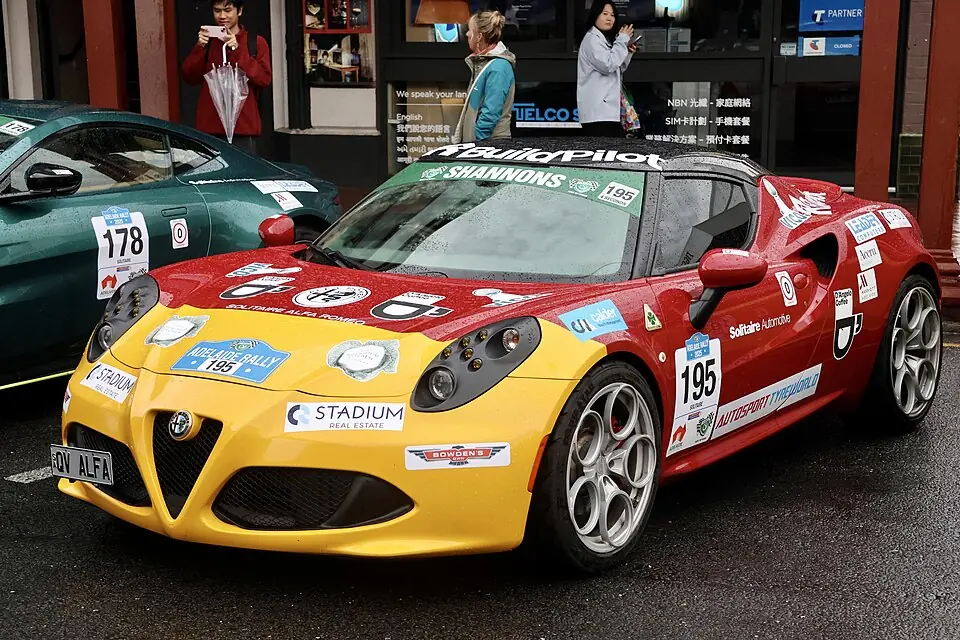
Alfa Romeo 4C
Why 5.0: A carbon monocoque and unassisted steering at Cayman money, hobbled by a DCT-only gearbox and a punishing daily manner. Owners either drive them hard or barely at all — the split personality shows in the data.
Layout
Natural habitat
Ride comfort
Sound
There is no bulkhead insulation at all, so the 1.75 turbo four's wastegate chatter, blow-off and gear whine arrive raw and close. But the engine is a humble Fiat unit capped at 6,500 rpm with a boosted, flat top end. Loud and interesting, not tuneful.
4-cylinder · turbocharged · 6,500 rpm redline · rated 6.0 / 10 for engine sound
Market value
Median asking price, good condition · €55k (2015) → €60k (2026), trending up · illustrative data
Child seats · ISOFIX
There aren't any — strict two-seater.
The owner's manual's Child Restraints chapter covers seatbelt and tether installation at length but never once names ISOFIX or LATCH lower anchors — a manual that does have them (Mini, Audi) says so explicitly.
Strict two-seat carbon-tub layout; the manual's own boilerplate keeps saying "the rear seat, if available," a tacit admission there isn't one.
Alfa Romeo 4C Owner's Manual, Child Restraints chapter
The long version
A chunk of first owners bought the 4C expecting a usable sports car and sold within a year or two once the unassisted steering and the jerky low-speed DCT made commuting a chore — that disappointment cycle shows up as steady churn on the used market rather than long-term holds. The owners who stuck around mostly figured out early that the car rewards a back road and punishes a parking lot, and they have built their usage around the former. It is a genuinely exotic chassis at a non-exotic price that never quite found an ownership base built to match its temperament.