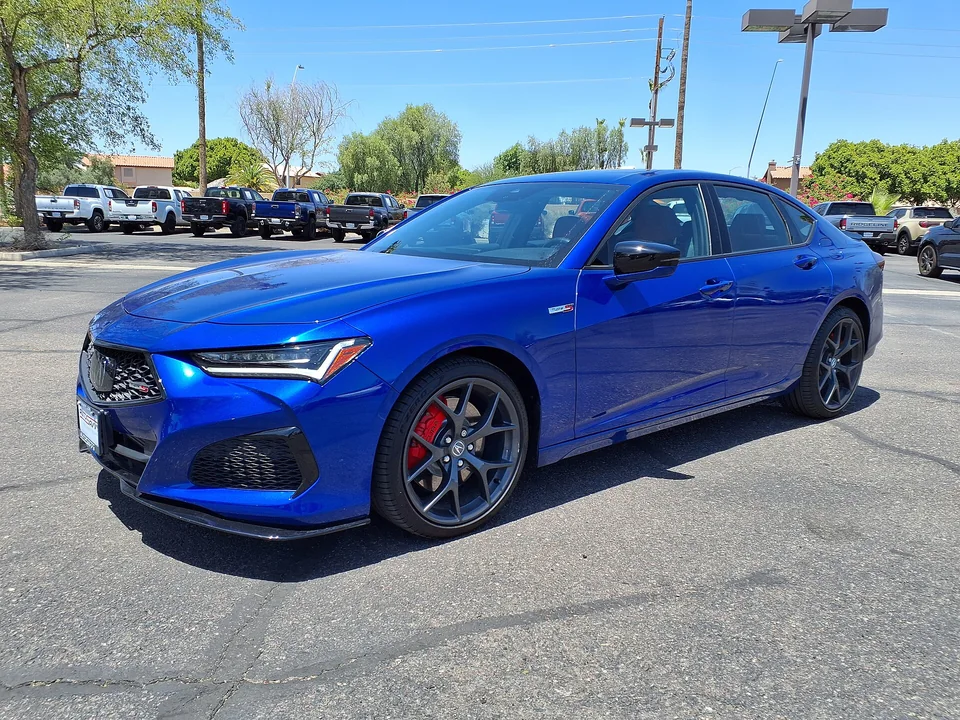
Acura TLX Type S
Why 8.4: The Type S badge came back after a decade with a 3.0-litre turbo V6 built for the badge and fitted to nothing outside the Type S line, four-piston Brembos, adaptive dampers and Super Handling All-Wheel Drive that will send 70 per cent of torque rearward and then 100 per cent of that to one rear wheel.
Layout
Natural habitat
Ride comfort
Sound
The Type S runs a valved quad-outlet exhaust and Acura tuned the single-turbo V6 to crack on upshifts, which is more theatre than any TLX has ever had. But a good share of what you hear is Active Sound Control playing through the stereo, and 6,500 rpm on a boosted V6 leaves nothing to build to.
6-cylinder · turbocharged · 6,500 rpm redline · rated 5.2 / 10 for engine sound
Market value
Median asking price, good condition · €49k (2021) → €31k (2026), trending down · illustrative data
Child seats · ISOFIX
Two ISOFIX positions on the outer rear seats, the outer pair being the ones the standard covers.
The rear anchors are the supported route — the manual points child seats there, and front-passenger ISOFIX is the exception rather than the rule. A belt-mounted seat up front needs the airbag off, and cars with a rear row don't always fit a deactivation switch, precisely because the rear seats exist.
Derived from production years and seating layout, not a per-car source. ISOFIX was standardised as ISO 13216 in 1997, required on new EU model types from 2011 and on all new EU cars from 2014.
The long version
Acura spent the 2010s being the brand nobody could describe, and the second-generation TLX was the attempt to fix it: a longer, wider, double-wishbone-front chassis unique to Acura rather than shared with the Accord, topped by a Type S with an engine developed for the job. Nothing outside the Type S badge uses that 3.0 turbo V6. The result was a car that reviewed well and sold in small numbers against Germans that outspend it on marketing by an order of magnitude, which is the entire reason it scores where it does here. There is no speculative interest in a TLX Type S and there will never be one — it is a front-drive-based luxury sedan from a brand with no auction history, and it depreciates on the ordinary schedule of a mainstream car rather than the gentler curve of a badge people covet. What is left after two years is a 355 hp, all-wheel-drive, Brembo-braked sport sedan with a Honda service schedule for the price of a well-specified Camry, bought by people who did the arithmetic. They commute in them. They put winter tyres on them. The Type S is quick enough to justify the odd track day and cheap enough that nobody worries about the miles, which is exactly the ownership pattern this index was built to reward.