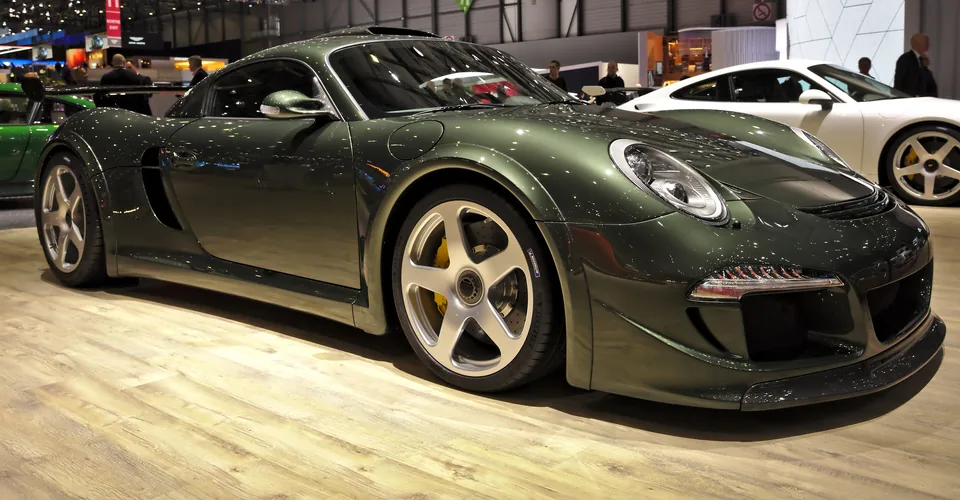
RUF CTR3
Why 3.0: RUF's own tubular and carbon structure behind a 987-derived cabin, with the twin-turbo flat-six moved ahead of the rear axle and a gearbox RUF commissioned rather than bought from Porsche. 700 hp, around 1,400 kg, and roughly thirty cars — a manufacturer's car with a manufacturer's VIN, not a conversion.
Layout
Natural habitat
Ride comfort
Sound
RUF mounted the twin-turbo 3.8 flat-six amidships, directly behind the cabin, so wastegate chatter and induction noise arrive unfiltered. But it remains a turbocharged flat-six, and the top end is compressed where an NA six would climb.
6-cylinder · turbocharged · 7,000 rpm redline · rated 7.5 / 10 for engine sound
Market value
Median asking price, good condition · €442k (2008) → €966k (2026), trending up · illustrative data
Child seats · ISOFIX
There aren't any — strict two-seater.
The only position there is, so makers of this era equip it: expect a passenger-airbag cut-off (key switch or occupant sensing) as standard, because there is no rear row to point children to. Whether the seat itself carries ISOFIX anchors is maker-specific — Porsche bundles them with its child-seat preparation, Ferrari sold them as an option, others are belt-mount only with the airbag off.
Derived from production years and seating layout, not a per-car source. ISOFIX was standardised as ISO 13216 in 1997, required on new EU model types from 2011 and on all new EU cars from 2014.
The long version
The Yellowbird made RUF famous by beating the factory at its own game with a modified 911 shell; the CTR3 is the point where RUF stopped modifying anything. Only the front half is recognisably Porsche — behind the doors it is a bespoke chassis with the engine relocated to a mid position, which is a structural change no tuner attempts and the clearest possible statement that RUF is legally its own manufacturer. Around thirty were built at prices that put them alongside the era's factory hypercars, and the population has behaved accordingly: they appear at concours and RUF anniversary events, occasionally at a track day, and very rarely on a road. The Clubsport that followed pushed output past 770 hp and did nothing to change the mileage.