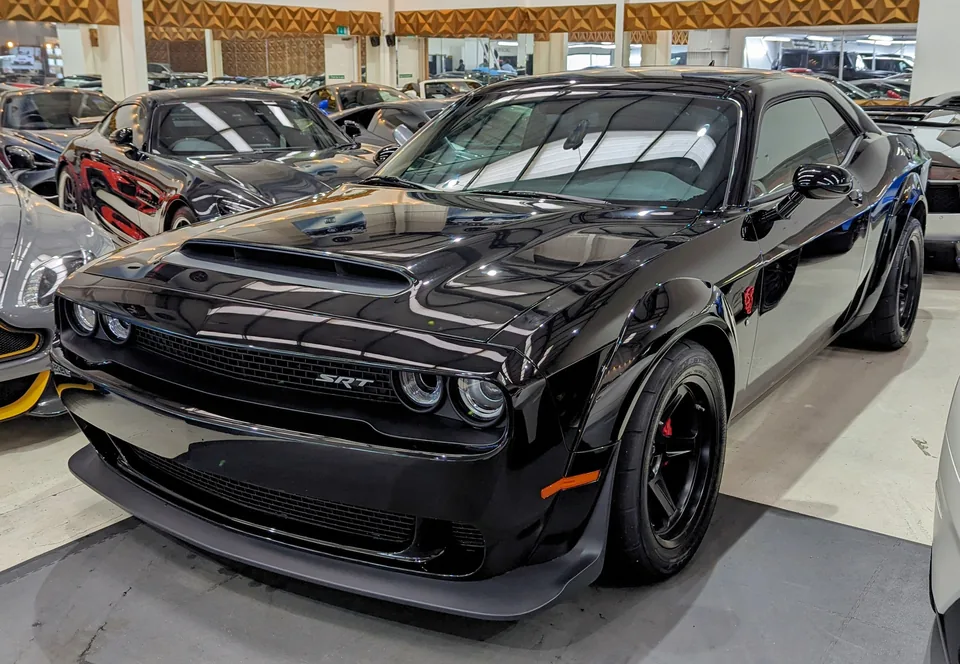
Dodge Challenger SRT Demon
Why 7.3: The quickest production car Dodge ever made, cleared 9-second quarter miles, was banned from NHRA competition and came with its own crate of drag radials and a spare ECU. One model year, 3,300 US units. Collectors keep them pristine; drag-strip regulars keep them at 8.9 seconds.
Layout
Natural habitat
Ride comfort
Sound
The 2.7-litre blower on the 6.2-litre Hemi produces the most recognisable supercharger whine in production, over a pushrod idle you feel through the floor. But it is a two-valve engine stopping at 6,500 rpm — all bottom-end menace and no climb.
8-cylinder · supercharged · 6,500 rpm redline · rated 7.4 / 10 for engine sound
Market value
Median asking price, good condition · €79k (2018) → €110k (2026), trending up · illustrative data
Child seats · ISOFIX
There aren't any — strict two-seater.
US-market Challengers don't put LATCH anchors in the front passenger seat — rear-only, consistent across model years per Cars.com's hands-on car-seat checks.
Standard configuration shipped with only a driver's seat — front passenger and rear bench were each $1 delete-delete options for drag-strip weight savings, so plenty of real cars have no passenger seat to put a child in at all.
Cars.com Car Seat Check (Dodge Challenger) (owner-community sourced, not manufacturer documentation)
The long version
FCA pressed the Demon concept hard enough that it got the car banned from organised drag racing, which turned out to be the best marketing decision of the decade. Every restriction the NHRA imposed — no cage, no parachute, too fast — was a headline, and the headlines drove waiting lists at dealers who marked the cars up by five figures. Values split into two camps: concours-condition low-mileage examples that appreciate like a muscle car should, and hard-driven examples that go to the drag strip every weekend and depreciate accordingly. The mileage factor is high because the people who bought these for the drag strip actually use them for it.