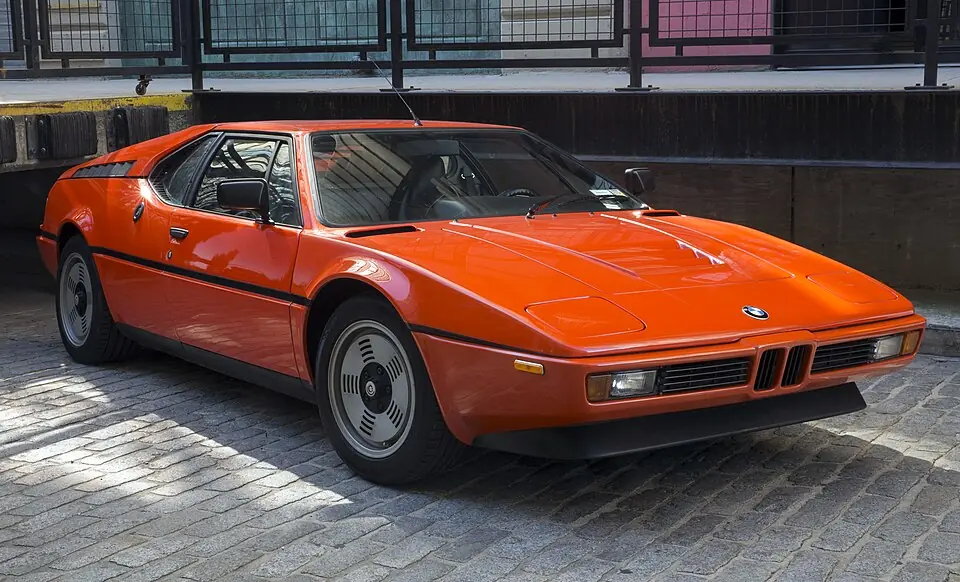
BMW M1
Why 4.3: 277-hp M88 six, a proper ZF five-speed, and a mid-engine chassis built to homologate Procar racing — genuinely great to drive by any era's standard. Never federalized for the US, so the surviving 453 cars are almost all grey-market imports that mostly sit in collections now.
Layout
Natural habitat
Ride comfort
Sound
The M88 breathes through six individual throttle bodies a foot behind the bulkhead, so induction is as much of the noise as the exhaust. It is capped by 6,900 rpm and a civil road silencer, which puts it level with the best naturally aspirated sixes rather than above them.
6-cylinder · naturally aspirated · 6,900 rpm redline · rated 8.3 / 10 for engine sound
Market value
Median asking price, good condition · €106k (1979) → €662k (2026), trending up · illustrative data
Child seats · ISOFIX
Built before ISOFIX existed, so there are no anchor points at all. A child seat here is a seatbelt installation in the only passenger seat there is.
Derived from production years and seating layout, not a per-car source. ISOFIX was standardised as ISO 13216 in 1997, required on new EU model types from 2011 and on all new EU cars from 2014.
The long version
BMW built just enough of these to satisfy Group 4 homologation, farming assembly out to Baur and Italian coachbuilders when its own factory politics fell apart, and the result was a race-bred chassis wrapped in a Giugiaro wedge that never got the works effort its engineering deserved. It was never sold new in the US, so every American example arrived through grey-market paperwork, and that filtering alone skews the surviving population toward collectors who researched the car for years first. Values have roughly sextupled since the 2000s trough, and a car this rare mostly gets trailered to concours lawns rather than driven to the shops.