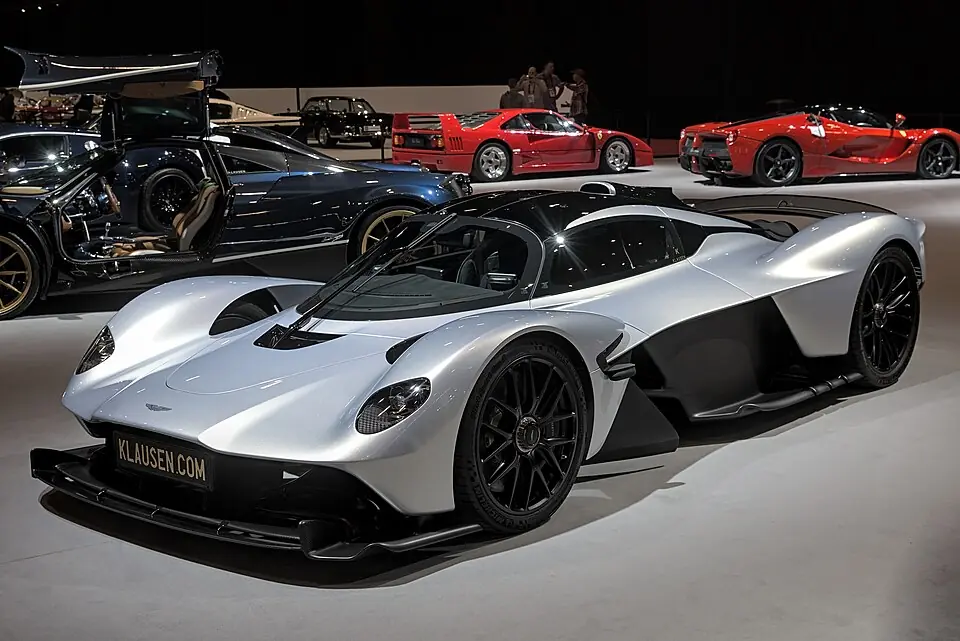
Aston Martin Valkyrie
Why 4.0: Adrian Newey's Cosworth V12 spins to 11,100 rpm — the strongest powertrain lens in this batch — and the ground-effect chassis is F1-adjacent in the literal sense. The motorsport-derived sequential gearbox has no clutch pedal, and that's the one lens keeping it out of Carrera GT territory.
Layout
Natural habitat
Ride comfort
Sound
The Cosworth 6.5 V12 revs to 11,100, higher than any road car engine before it, and exits through a top-mounted pipe with almost nothing between it and the cabin. It gives up a fraction to the Carrera GT only because so much gearbox and tyre noise competes with it.
12-cylinder · naturally aspirated · 11,100 rpm redline · rated 9.7 / 10 for engine sound
Market value
Median asking price, good condition · €3.2M (2021) → €3.8M (2026), trending up · illustrative data
Child seats · ISOFIX
There aren't any — strict two-seater.
Fixed carbon seat shells are mounted straight to the tub in an F1-style reclined position, with a standard 4-point harness (6-point optional) — there's no conventional seat to attach a child restraint to.
The manual carries the standard rearward-facing-seat-and-airbag warning, but with harness-only fixed seats it reads as boilerplate rather than a real scenario.
Aston Martin Valkyrie Owner's Handbook (owner-community sourced, not manufacturer documentation)
The long version
Aston Martin screened Valkyrie buyers for driving intent rather than portfolio diversification, borrowing the vetting playbook McLaren used for the Senna, and the car's extreme packaging — a reclined seat, minimal luggage space, ride height too low for most driveways — makes it genuinely impractical for anything but a circuit or a closed road. That impracticality has, perversely, protected the ownership pattern: owners who complained about ground clearance on delivery day generally end up trailering the car to track days instead of leaving it parked. Values have already started climbing since deliveries wrapped.