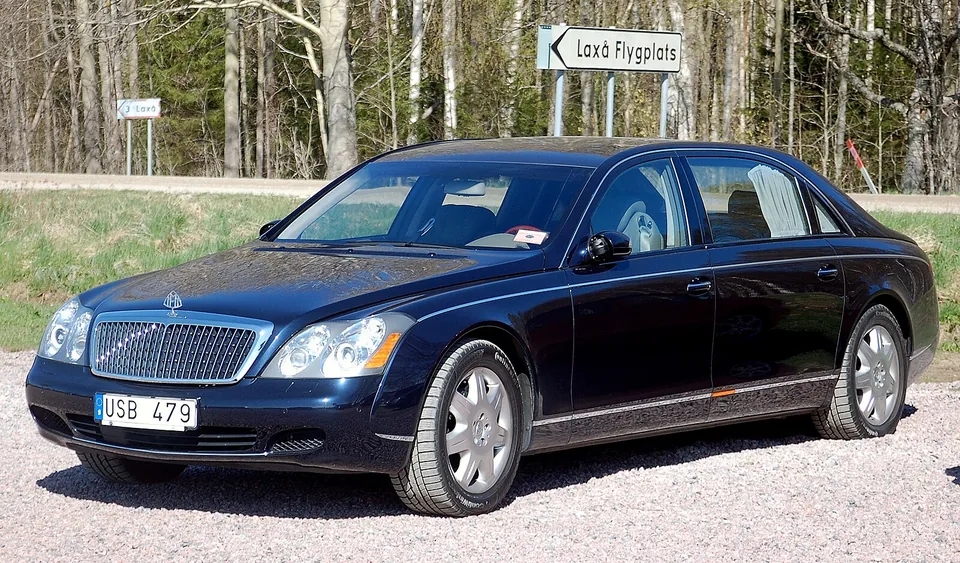
Maybach 62
Why 5.0: Daimler revived a dead pre-war marque, spent a fortune, and sold about 3,300 cars across a decade against Rolls-Royce's far healthier numbers. A $385,000 limousine that fell under $70,000 within twelve years is not a car anyone stores hoping for a return.
Layout
Natural habitat
Ride comfort
Sound
There is a twelve-cylinder swell under full throttle and 900 Nm behind it, so something is clearly happening. But Maybach's written target was a rear compartment quieter than a Phantom's, and the M285 sits behind double glazing, sealed doors and a couple of hundred kilos of insulation. You feel the shove and hear none of it.
12-cylinder · turbocharged · 6,000 rpm redline · rated 2.8 / 10 for engine sound
Market value
Median asking price, good condition · €354k (2006) → €101k (2026), trending down · illustrative data
Child seats · ISOFIX
ISOFIX was spreading through these years rather than fitted across the board — whether a given car has rear anchors depends on its year and market.
Children were expected in the back. Front-passenger ISOFIX effectively didn't exist in this era, and airbag deactivation was patchy — treat the front seat as a no unless a specific car proves otherwise.
Derived from production years and seating layout, not a per-car source. ISOFIX was standardised as ISO 13216 in 1997, required on new EU model types from 2011 and on all new EU cars from 2014.
The long version
The 62 is 6,165 mm long — over six metres — on a 3,827 mm wheelbase, weighs 2,805 kg, and puts fully reclining rear seats behind an electrochromic glass partition, all of it wrapped around a W140-derived floorpan that was already old when the car launched in 2002. The engineering target was a rear compartment quieter than a Phantom's, and by most accounts it hit that. The commercial target it missed completely: Maybach never came close to Rolls-Royce volumes, lost money for a decade, and was killed in 2012 before being resurrected as a Mercedes trim level. For this Index, that failure is the interesting part. Nothing collapses in value like an ultra-luxury flagship whose maker has abandoned it, and a car that lost more than eighty per cent of its list price attracts precisely zero speculation — the not-flipped score here is among the highest on the trophy shelf and it is entirely deserved. What the survivors do instead is work. They turn up as wedding cars, as chauffeur hire, as the odd well-kept collection piece, quietly depreciating and occasionally accumulating real mileage. Mileages stay modest — many are still under 50,000 miles after twenty years — but a used Maybach 62 is a car that gets ridden in, not a car that gets banked.